How can automated driving functions be developed to be safe, intuitive, and high performing? At GM, the answer lies in a comprehensive process of highly realistic cross-domain simulation and validation that ensures a reliable signal chain from sensors to functional logic to actuators.
The new L234 vehicle platform from General Motors (GM), on which the Cadillac Vistiq is based, is equipped with a Level 2+ ADAS system. Eleven cameras, one radar, and one lidar sensor are used for environmental perception. The driving functions (motion control) use this sensor data to control electric actuators such as the electronic brake and electric power steering (EPS). The goal of GM’s validation project is the robust verification of all Level 2+ functions under deterministic real-time conditions and taking the specific requirements of regional markets into consideration.
For quick readers:
As ADAS systems grow in complexity and regional requirements diverge, ensuring deterministic, reproducible validation across sensors, ECUs, and actuators has become a critical business and safety challenge. GM validates the Level 2+ ADAS functions of the the Cadillac Vistiq platform using a cross-domain HIL and simulation environment. The integrated setup enables realistic sensor simulations, closed-loop actuator testing, and reproducible validation of perception, decision logic, and motion control.
How can automated driving functions be robustly and systematically validated?
Autonomous and highly automated driving functions require full validation of the entire functional chain – from sensors through perception and decision logic to actuators.
GM achieves this through:
- Established safety-oriented development processes
- Simulation-based functional evaluation
- Hardware-in-the-loop (HIL) tests with highest accuracy and real-time conditions
- The goal is a reproducible, standards-compliant release at the ECU and system levels.
What technical challenges arise in the integral HIL-based validation of all vehicle domains?
Integral validation of the ADAS/AD signal chain involves numerous highly complex, safety-critical components and, for the GM vehicle platform, therefore requires:
- Deterministic generation of realistic sensor data, e.g., camera, lidar, radar
- Real-time vehicle dynamics simulation combined with dynamic traffic and environment scenarios
- Closed-loop testing with safety-critical actuator systems, such as:
- Electronic brake control module (EBCM)
- Electric power steering (EPS)
- Complete simulation of vehicle network communication, including CAN, Ethernet, and diagnostics protocols
- Fault-injection mechanisms to assess robustness and safety reactions
Together, these measures enable the simulation of real-world vehicle behavior – including failures, performance degradation, and rare edge cases – in a HIL environment at a physically accurate level.

Principle of the HIL setup, which integrates vehicle sensors (cameras, lidar, radar), actuators (steering, brakes), and the ADAS ECU in a closed-loop environment.
How is cross-domain HIL validation achieved?
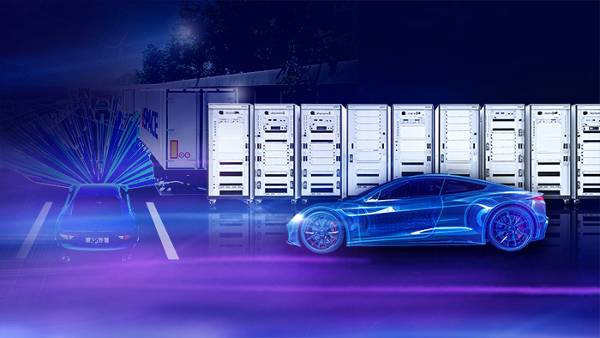
For cross-domain validation, GM uses a modular HIL architecture consisting of:
- dSPACE HIL simulators for real-time model execution and ECU integration
- Mechatronic test benches (e.g., brake and steering systems) for coupling real actuators into the test setup
- Dedicated gateways for fault injection at both signal and vehicle network levels
This modular architecture enables deterministic and repeatable test execution, as well as high-resolution analysis of functional behavior and safety mechanisms across multiple vehicle domains.
The integration of mechatronic test benches is essential to extend classical ECU-level HIL testing toward physical closed-loop validation. By coupling real brake and steering actuators into the HIL setup, GM is able to validate not only control logic and communication timing, but also actuator dynamics, physical load behavior, and safety-critical interactions between software and hardware under realistic operating conditions.

How can dynamic traffic and environment scenarios be generated?
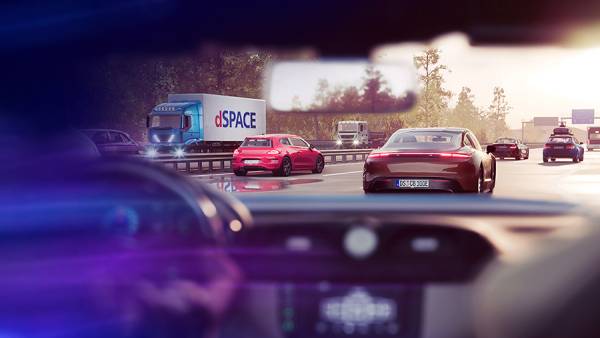
Realistic traffic and environment scenarios are essential for the validation of ADAS functions. For this purpose, the simulation tools from dSPACE play a key role in validation at GM. The Automotive Simulation Models (ASM) tool suite is used to simulate a wide range of traffic scenarios, including relevant edge cases. Traffic scenarios are drawn from a predefined scenario library and can be automatically varied through parameterization. Based on the traffic simulation, AURELION generates a sensor-realistic, fully immersive 3D environment that produces physically accurate sensor data such as camera raw data and lidar point cloud data.
Together, ASM and AURELION enable:
- Physically correct vehicle dynamics behavior and maneuvers for ego-vehicles and traffic vehicles
- High variability and scalability of scenarios to increase test coverage
- Sensor-realistic environment and sensor frontend simulation with validated camera, radar, and lidar models, (as well as radar simulation based on object lists via CAN)
- Deterministic generation of camera raw data and lidar point clouds, including complex and safety-critical traffic situations
This integrated approach allows the consistent, repeatable, and reproducible creation of complex dynamic traffic and environment scenarios for reliable ADAS validation in a HIL environment.
How can ADAS sensors be integrated into HIL simulation?
Depending on the test objective, several sensor-integration options are available in HIL simulation. The appropriate approach is determined by the required level of realism and by which part of the sensor system is to be validated:
- For maximum realism, over-the-air (OTA) stimulation of the physical sensor can be used.
- A highly realistic alternative is sensor simulation at raw data level fed into the corresponding ECU inputs.
- For many validation tasks, ideal ground-truth sensor simulation is sufficient, where sensor outputs (e.g., object lists) are simulated and provided directly to the ADAS ECU.
In GM’s project setup, camera sensors play a particularly important role. Therefore, a high degree of realism in the sensor raw data was required. Raw-data-based sensor simulation was selected to enable realistic and vehicle-representative perception validation.
Integration via raw-data injection:
In the case of raw-data injection, ADAS sensors impose specific integration requirements due to vendor-specific interfaces, protocols, and sensor metadata. The dSPACE tool chain addresses these challenges through a continuous sensor processing chain: Sensor raw data generated in AURELION is processed in the Environment Sensor Interface (ESI) Unit (Environment Sensor Interface Unit), adapted as required, and transmitted to the ADAS ECU via the appropriate physical interface and protocol. Camera signals are transferred via ESI Units to the ADAS ECUs, enabling perception-level validation under vehicle-representative conditions.
The following sensor-specific properties are taken into account:
- Timing and synchronization signals
- Sensor metadata, such as exposure control and histogram information
- Standardized SerDes (Serializer/Deserializer) interfaces and protocols, e.g., MIPI A-PHY and ASA-ML
- Proprietary SerDes interfaces and protocols, e.g., ADI GMSL and TI FPD-Link
Using ESI Units, GM validated the following sensor configurations in the HIL environment:
- 4 × 2 MP (megapixel) fisheye cameras
- 5 × 3 MP cameras
- 2 × 8 MP cameras
The camera model could be parameterized for the individual camera types based on their data sheets, enabling accurate and type-specific camera simulation.
The ESI Units ensure bit-accurate and timing-accurate sensor simulation, enabling faithful integration of the camera sensors into the closed-loop HIL test setup.
Integration at the network level:
- The lidar point clouds simulated with AURELION are transferred to the ECU via Ethernet.
- Radar sensors were integrated using simulated radar targets, generated as object lists and transmitted to the ECU via CAN.
This synchronized approach enables traffic and environment simulation for ADAS that fulfills all plausibility requirements and ensures that the ADAS ECU operates under the same conditions as in the vehicle. As a result, GM was able to validate perception and downstream control logic under vehicle-representative sensor conditions while maintaining full determinism and reproducibility.
“The dSPACE HIL simulators enable us to perform reproducible tests and detailed evaluation of ADAS/AD functions and safety mechanisms.”


What selection criteria were important to GM?
Given the demanding nature of ADAS validation – particularly with regard to safety-critical functionality across multiple vehicle domains – GM selected dSPACE based on the following key criteria:
- Long‑standing experience in the development of cross‑domain HIL systems, covering ADAS, chassis, and vehicle network architectures
- Proven expertise in sensor simulation and sensor integration, including camera, lidar, and radar technologies
- Validated sensor models and demonstrated competence in the synchronous simulation of sensor raw data, ensuring timing-accurate and vehicle-representative validation
- Open and modular system architecture, offering flexible interfaces for the integration of third-party tools and customer-specific components such as mechatronic test benches
What role did dSPACE products play in the validation system?
dSPACE products made a significant contribution to the overall success of the GM validation project by providing realistic environment and sensor simulation, reliable and deterministic testing for ADAS/AD ECU validation and release, and a stable, integrable platform for cross-domain HIL testing including mechatronic actuators. Controlled fault injection and the integration of high-resolution navigation maps further supported the robustness assessment and market-specific AD functions. Overall, the dSPACE systems met all functional and process requirements and enabled the timely release of ECUs and vehicle-level ADAS/AD functions.
“AURELION provides us with a sensor-realistic 3D environment simulation that enables us to test camera and lidar functions under identical conditions and cover complex traffic scenarios in a reproducible manner.”


Does the solution have potential for the autonomous future?
By combining simulation-based functional evaluation, cross-domain HIL integration, and sensor-realistic simulation, GM has established a scalable and future-proof validation framework that supports current Level 2+ systems and provides a solid foundation for higher levels of automated driving.
Courtesy of GM
dSPACE MAGAZINE, PUBLISHED MAY 2026
The article was created in close cooperation with the following persons:

Yong Wang
Manager Automated Driving Software Integration, GM China

Xiaoshan Huang
New Technology Development Bench Lead, GM China

Quan Cao
Senior HIL Simulation Engineer, GM China

Hao Tan
Senior HIL Simulation Engineer, GM China

Yiming Chen
Senior HIL Simulation Engineer, GM China

Ting Zhu
Senior HIL Simulation Engineer, GM China

Chao Hu
Controller Integration Engineer, GM China
Insights into the ADAS and chassis HIL architecture
The integrated platform for HIL testing spans both ADAS and chassis domains and covers:
ADAS ECUs and sensors
- Vehicle dynamics and traffic simulation using the ASM (Automotive Simulation Models) tool suite
- Validated environment and sensor models, implemented in
- AURELION (GPU-based) for high-fidelity sensor and environment simulation
- ESI Unit (FPGA-based) for deterministic, low-latency sensor signal injection
- Real-time validation of perception, fusion, and decision logic using the exact same communication interfaces and protocols (FPD-Link, Ethernet), as in the vehicle
Electronic Brake Control Module (EBCM including ABS, TCS, ESP)
- Mechatronic bench provided by GM
- Simulation of wheel speed, longitudinal and lateral acceleration, and yaw rate
- Evaluation of hydraulic-electric actuator behavior under closed-loop conditions
Electric Power Steering (EPS)
- Mechatronic bench provided by dSPACE
- Road and chassis models for realistic steering torque simulation
- Validation of safety-relevant control logic, including fallback strategies and torque limitation functions
Network & Diagnostics
- Full integration of in-vehicle networks, including CAN and Ethernet
- Restbus simulation for all relevant communication nodes
- Diagnostic and communication analysis under functional and fault conditions
In brief
Task
- Cross-domain validation of automated driving functions – from sensors to actuators
Challenge
- Validating complex multi-sensor ADAS setups at system level
- Ensuring safe closed-loop behavior of braking and steering functions
- Achieving reproducible validation results across operating scenarios
Solution
- Integrated cross-domain HIL platform combining simulation (sensors) and real hardware (actuators)
- Sensor-realistic camera simulation using bit- and timing accurate raw-data injection (ESI Unit)
- Virtual traffic, environment, and vehicle dynamics simulation at scale (ASM, AURELION)
Benefit
- Deterministic, reproducible ADAS/AD testing outcomes
- High safety coverage and test depth
- Reliable ECU and vehicle release within planned timelines