
dSPACE Smart Charging Solution Supports the Korean Safety Communication Standard for EV Charging
- Automotives
- HIL Testing
- E-Mobility
12:44min
Overview
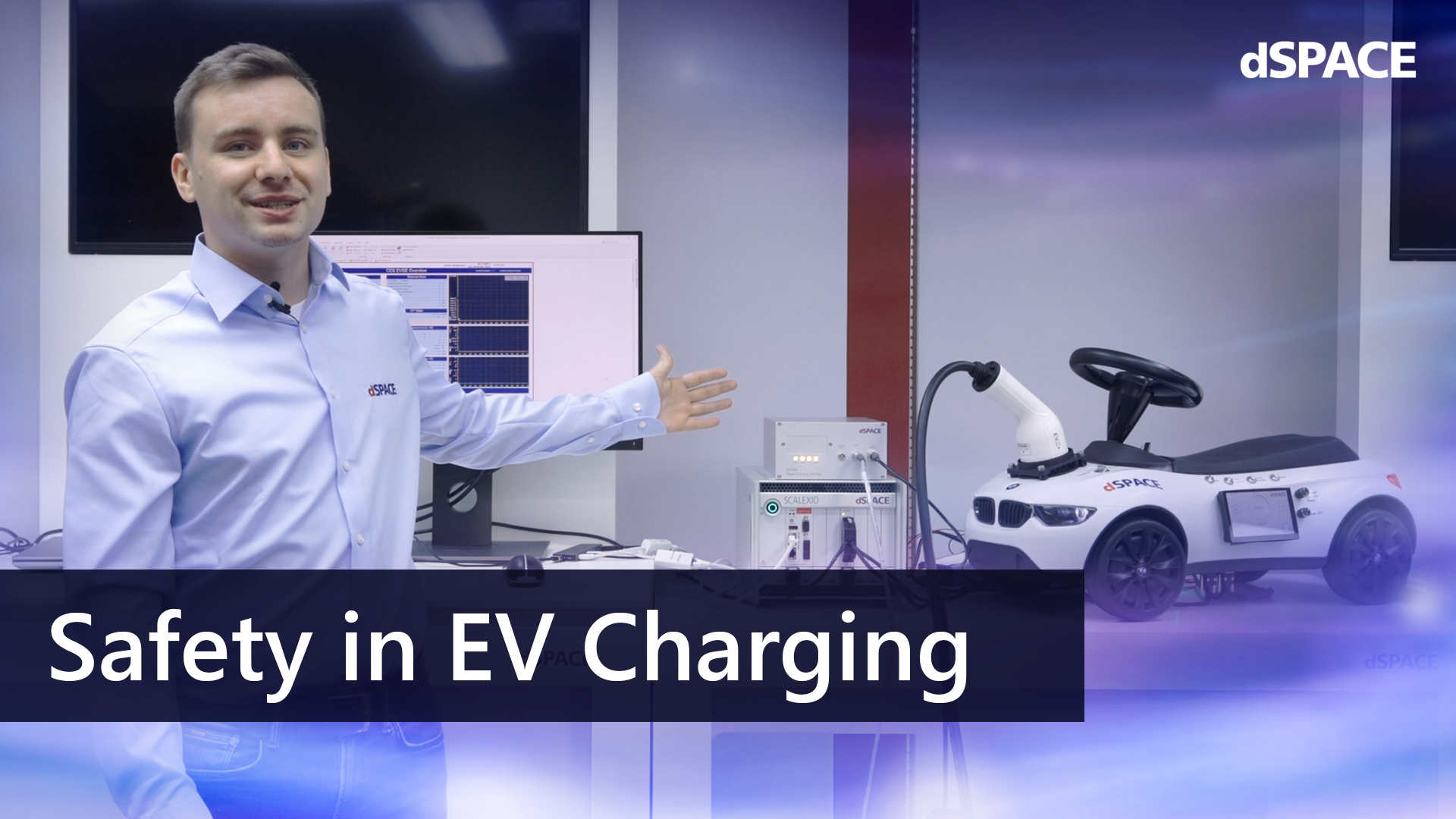
Would you like to know how the safety of charging electric vehicles (EV) can be further improved? Learn more about the Battery Data Exchange Protocol, a communication standard introduced in South Korea and based on ISO 15118. The protocol adds an extra layer of communication between the EV and the charging station. It enables the continuous transmission of key battery parameters, such as state of charge (SOC), state of health (SOH), and temperature, to help detect potential risks early.
The video demonstrates how developers can analyze, validate, and test this safety-related communication within their charging and hardware-in-the-loop (HIL) testing environments using the dSPACE Smart Charging Solution, ControlDesk, and the dSPACE Wireshark® plug-in. The dSPACE Solution is especially relevant for EV developers, charging infrastructure manufacturers, and HIL testing engineers who are looking to validate communication reliability, safety features, and protocol compliance.
Hosts

Thoren Grüttemeier
Software Developer, dSPACE
FAQ
Q1: What is the Battery Data Exchange Protocol and why is it important for electric vehicle charging?
A1: The Battery Data Exchange Protocol is a safety‑oriented communication method that enables continuous transmission of key battery information – such as state of charge, state of health, and temperature – from the EV to the charging station. This additional data helps detect potential risks early and supports preventive safety measures during charging.
Q2: How does the Battery Data Exchange Protocol relate to the ISO 15118‑2 charging standard?
A2: The Battery Data Exchange Protocol complements ISO 15118‑2 by adding an extra communication layer implemented as a value-added service (VAS). This allows battery-related information to be exchanged without interfering with the standard ISO 15118-2 charging processes.
Q3: What battery information is exchanged using the protocol?
A3: The protocol transmits key battery parameters, including:
- State of charge (SOC)
- State of health (SOH)
- Battery temperature
This information helps assess whether the battery remains within expected operating ranges during charging.
Q4: How can engineers validate or test the Battery Data Exchange Protocol during development?
A4: The dSPACE Smart Charging Solution and ControlDesk help engineers initiate and monitor battery data exchange, analyze communication behavior, and validate correct implementation. In addition, Wireshark® together with the dSPACE Wireshark® plug-in allows capturing, decoding, and analyzing Battery Data Exchange Protocol messages in detail.
Q5: What role does the dSPACE Wireshark® plug-in play in working with this protocol?
A5: The dSPACE Wireshark® plug-in enables the decoding and visualization of Battery Data Exchange Protocol communication inside Wireshark®, supporting transparent inspection, troubleshooting, and verification of message content.