
dSPACE Smart Charging Solution Supports the Korean Safety Communication Standard for EV Charging
- Automobiltechnik
- HIL-Tests
- Elektromobilität
12:44min
Übersicht
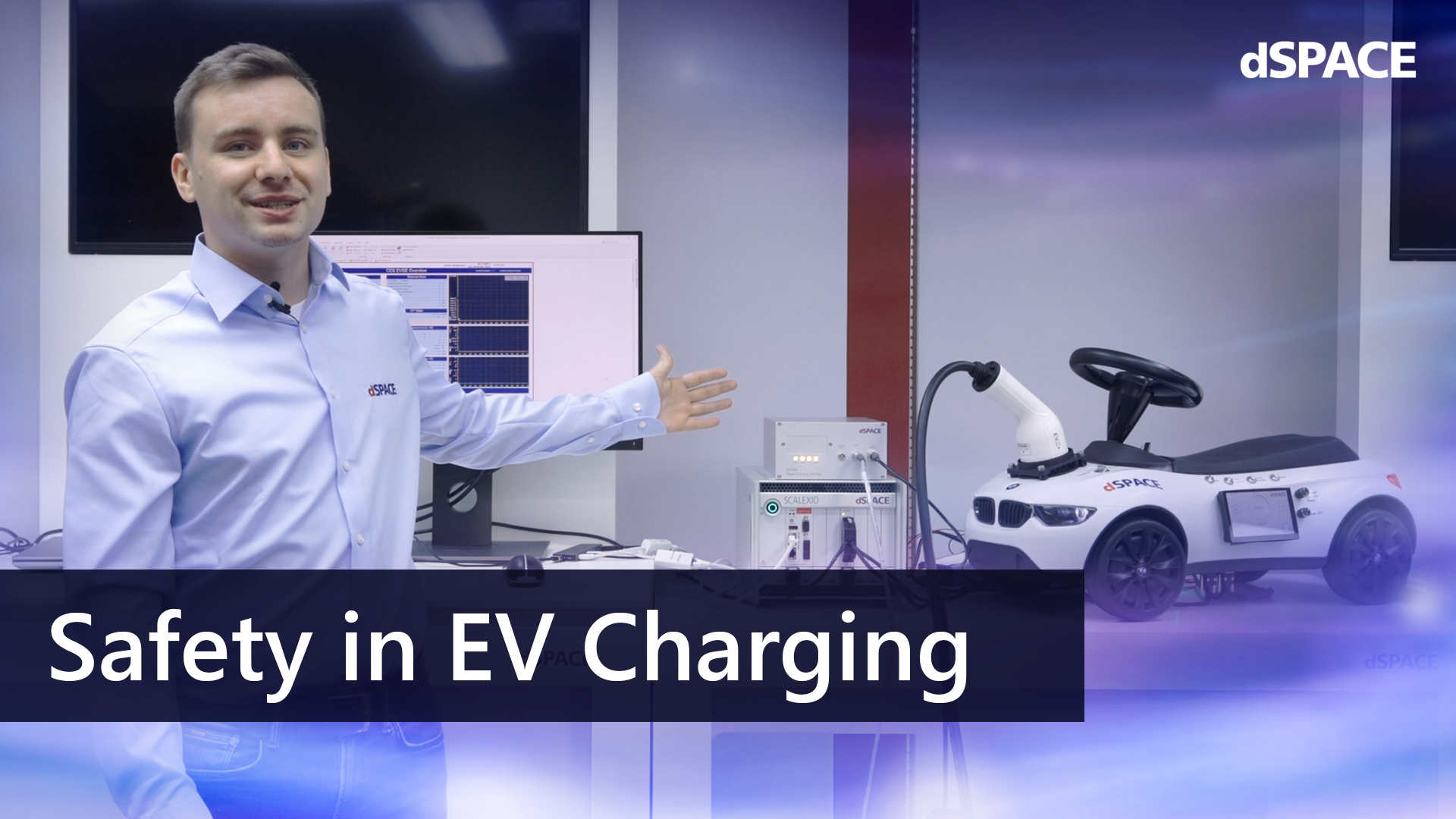
Would you like to know how the safety of charging electric vehicles (EV) can be further improved? Learn more about the Battery Data Exchange Protocol, a communication standard introduced in South Korea and based on ISO 15118. The protocol adds an extra layer of communication between the EV and the charging station. It enables the continuous transmission of key battery parameters, such as state of charge (SOC), state of health (SOH), and temperature, to help detect potential risks early.
The video demonstrates how developers can analyze, validate, and test this safety-related communication within their charging and hardware-in-the-loop (HIL) testing environments using the dSPACE Smart Charging Solution, ControlDesk, and the dSPACE Wireshark® plug-in. The dSPACE Solution is especially relevant for EV developers, charging infrastructure manufacturers, and HIL testing engineers who are looking to validate communication reliability, safety features, and protocol compliance.
Gastgeber

Thoren Grüttemeier
Software Developer, dSPACE
FAQ
Q1: What is a virtual sensor, and why is it useful in automotive applications?
A1: A virtual sensor is a software-based component that estimates physical sensor outputs using data from other available sensors. It reduces hardware complexity and costs while maintaining system functionality, which is particularly beneficial for safety-critical automotive systems.
Q2: How are neural networks developed and integrated into TargetLink for virtual sensors?
A2: Neural networks are developed externally using frameworks like Keras or PyTorch, trained with relevant data, and exported as ONNX files. These ONNX models are then integrated into TargetLink using the adaptable behavior feature, which links the model with MATLAB scripts that generate the necessary C code via external code generator for ECU deployment.
Q3: What role do MIL, SIL, and PIL simulations play in this integration process?
A3: MIL (Model-in-the-Loop), SIL (Software-in-the-Loop), and PIL (Processor-in-the-Loop) simulations verify the neural network’s behavior at different stages - from initial training, through generated code, to embedded hardware execution - ensuring consistency and accuracy across environments.
Q4: How does TargetLink ensure that the integration of the neural network model remains up to date?
A4: TargetLink includes an automated up-to-date check that runs before code generation. It verifies if the neural network model and the generated implementation are synchronized, triggering regeneration of code if needed, which maintains alignment and reduces manual errors.
Q5: Can this integration approach support multiple target hardware platforms?
A5: Yes, using TargetLink’s build extension feature, developers can specify different source files for different processors or hardware platforms within the TargetLink Data Dictionary, allowing easy switching between targets without modifying the model or reconfiguring the project.