• Advanced solution for validation of ADAS/AD domain controllers and high-performance computers (HPCs) with real-world data
  • Accurate hardware-synchronized replay of any number of heterogeneous data streams
  • High-performance data injection into all relevant raw sensor data and bus interfaces including service-oriented communication via SOME/IP
  • Real-time filtering and adaptation of the recorded data to cover ECU and board net changes and end-to-end security protection
  • Easy integration into data center infrastructure and hybrid cloud with support of remote operation and monitoring
  • Convertible into a closed-loop HIL for scenario-based testing with manageable additional effort

Task

Data replay based on real-world scenarios and performed on hardware is a common method for benchmarking different ECU versions, regression, back-to-back, and release tests, as well as for hardware debugging on the same level of realism as given by real test drives. Software components for sensor data fusion and activation of functions for autonomous driving tested previously in the development process now have to be deployed and validated on target hardware. The main objectives are to evaluate the correctness of interfaces for communication between real sensors and ECUs, and to ensure the performance, reliability, and security of the target system considering realistic data loads and timing conditions. Advanced data replay is a perfect match when the demand on flexibility and scalability of a test system is high, for example, when the focus is set on validating frequently changing versions and updates of the ECU or HPC, various board net versions must be considered, and bus data injection into lidar and radar sensors is done not only via Ethernet using TCP and UDP/IP, but also using service-oriented communication. Since the validation should be done on SUTs (systems under test) of different maturity up to series production level, the changing end-to-end security protection of the device must also be considered.  

Challenge

During data replay tests, ADAS/AD hardware platforms must be fed with heterogeneous data streams, including raw sensor and bus data, in the same manner as in the vehicle during real test drives. To be accepted by the SUT, all injected data must be replayed with high correctness and accuracy. A single platform for autonomous driving must be fed with perfectly synchronized data streams of 25 sensors and more in parallel, which in turn requires up to more than 40 Gbit/s bandwidth in some cases. Systems for autonomous driving based on HPCs often use service-oriented communication via SOME/IP. This requires appropriate filtering of bus frames in real-time during the replay. Further raw data and bus data adaptions are required when the ECU or board net version has changed. Another challenging aspect is the growing number of security and safety functions in the new ADAS/AD platforms. Some platforms are equipped with “Replay Attack” counter measures, which makes replaying the data directly as they are recorded invalid. To avoid this, the security header of the recorded data must be changed in real time prior to the injection. All the time, data replay testing is expected to be deterministic and reproducible and to perform realistic bus and system behavior. An increasing number of customers are using data centers to benefit from scaled performance and efficiency of compute and storage virtualization and high-speed cloud connection. Therefore, data replay systems must be easily integrable into hybrid cloud infrastructure and remotely controllable. The complexity of data replay increases rapidly – this requires the testing departments to frequently verify the quality of replay systems in parallel to the actual ECU validation. 
 

Solution

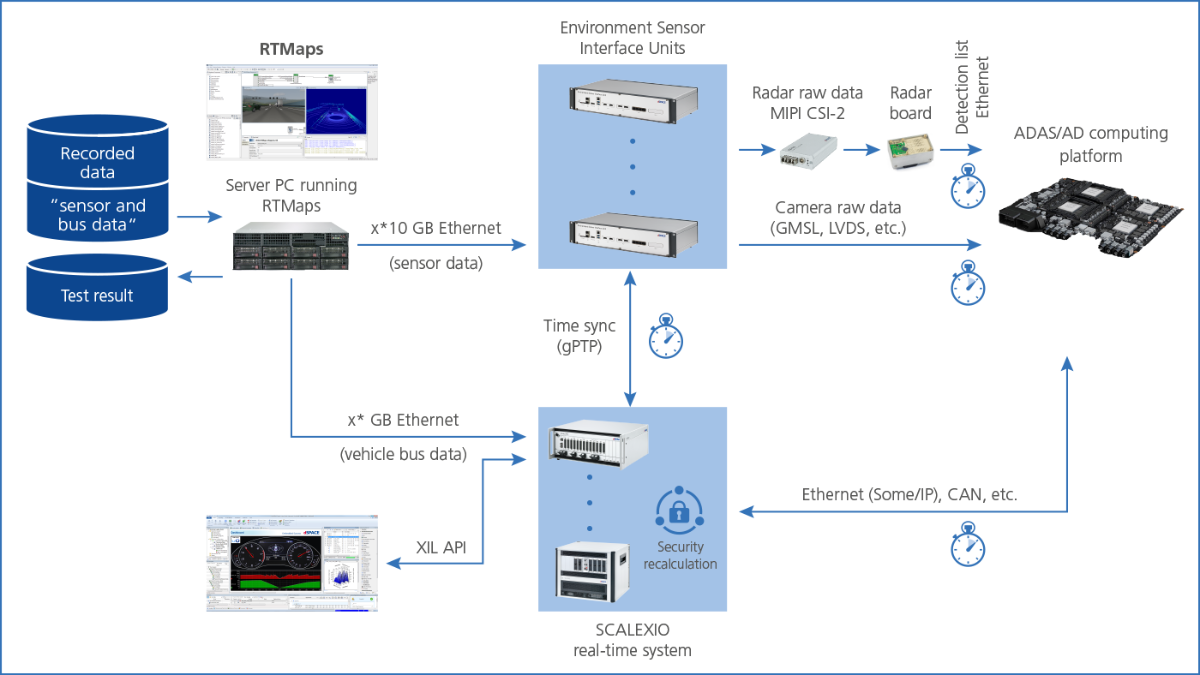
The dSPACE solution for advanced data replay to validate ADAS/AD domain controllers and HPCs typically consists of at least one Environment Sensor Interface (ESI) Unit for feeding raw sensor data and a SCALEXIO Processing Unit acting as a bus injection interface. To receive recorded data, sensor interfaces can be connected either to several replay PCs or integrated into a compute and storage infrastructure of a data center, which is increasingly the case in today's projects. Optionally, a data logger can be added as probe to log data streams injected into the SUT for subsequent data replay quality verification.  

One benefit of integration into a data center infrastructure is the ability to virtualize computing and storage resources for flexible and scaled testing. Due to the presence of high-throughput connections to the cloud data lake of up to 100 Gbit/s, data recordings and annotations used for replay and calculation of test results can directly be streamed down to the replay system or prestored in a local cache while an instance of RTMaps, the performance-optimized replay software from dSPACE, runs on a virtualized computer unit in a Docker container. After reading out the recordings, which can be done in different formats (MDF4, PCAP, rosbag…), RTMaps pushes the data directly or after some adaptions like decompression, adding pixel errors or removing bus frames, to dedicated interfaces for raw and bus data injection, the ESI unit, and the SCALEXIO Processing Unit. RTMaps can also be utilized afterwards to calculate key performance indicators (KPIs) by comparing the SUT output with provided annotations (reference data), and for verification of the correct replay system operation.

The modular FPGA-based ESI Unit for injection of raw sensor data can be individually equipped with a wide range of FMC modules to feed data into various interfaces of the SUT such as GMSL, FPD-Link, or MIPI CSI. The SCALEXIO Processing Unit maintains real-time replay of bus data streams that transport payloads like lidar point clouds or radar object lists via UDP/TCP/IP or CAN. On top of this, the high-performance processing unit fully supports bus injection via SOME/IP, including real-time frame filtering and manipulations of existing data recordings required to cover changes on the SUT, board net, and communication, and to meet E2E security updates. SCALEXIO also establishes high-quality restbus simulation to provide required vehicle bus data and keep the SUT at the expected operating point during the whole replay. Both, the ESI Unit and the SCALEXIO Processing Unit, are time-synchronized on hardware basis by gPTP (generalized Precision Timing Protocol) using the real-time clock of the SCALEXIO system as a master to ensure highly accurate injection of all parallel data streams into the ADAS/AD ECU with permanent low jitter below 1 ms.
 

Advanced data replay validation of AD domain ECUs and High-Performance Computers.

System modularity and flexibility is at the core of the dSPACE data replay solutions to scale validation. Growing bandwidth requirements paired with an increasing number of sensor interfaces can be covered by upgrading the replay system with additional ESI Units and SCALEXIO Processing Units. Integration into a data center allows the test environment to be expanded with a number of replay systems running in parallel for large scale testing. 

To fully support data center integration, the replay system can be remotely operated and monitored through open APIs. To ensure the high replay quality of such a complex test setup, the test environment can be enhanced by adding a probe data logger and the dSPACE Data Replay Validation solution. This allows regular checks of data streams to be fed into the SUT against existing test quality standards. 

With manageable additional effort, a replay system can also be converted into a closed-loop HIL to perform scenario-based testing, e.g., based on synthetic data generated by sensor models. 
 

Stay up-to-date with our dSPACE direct newsletter service.

With our dSPACE newsletter service, we will keep you informed about current use cases and new solutions and products, as well as trainings and events. Sign up here for a free subscription.

Enable form call

At this point, an input form from Click Dimensions is integrated. This enables us to process your newsletter subscription. The form is currently hidden due to your privacy settings for our website.

External input form

By activating the input form, you consent to personal data being transmitted to Click Dimensions within the EU, in the USA, Canada or Australia. More on this in our privacy policy.