DS5481 2-Channel Battery Cell Voltage Emulation Board

High-end board for simulating high-voltage batteries at cell level

With the DS5481, dSPACE offers a high-precision, two-channel SCALEXIO board for hardware-in-the-loop (HIL) testing of battery management systems (BMS) on the voltage level. The board makes it possible to simulate high-voltage batteries at cell level. It supports system voltages of up to 1,500 V and comes with integrated electrical failure simulation. BMS developers and test engineers can use the board for a wide range of applications across different industries – from battery electric vehicles on land, at sea, and in the air to stationary storage systems.

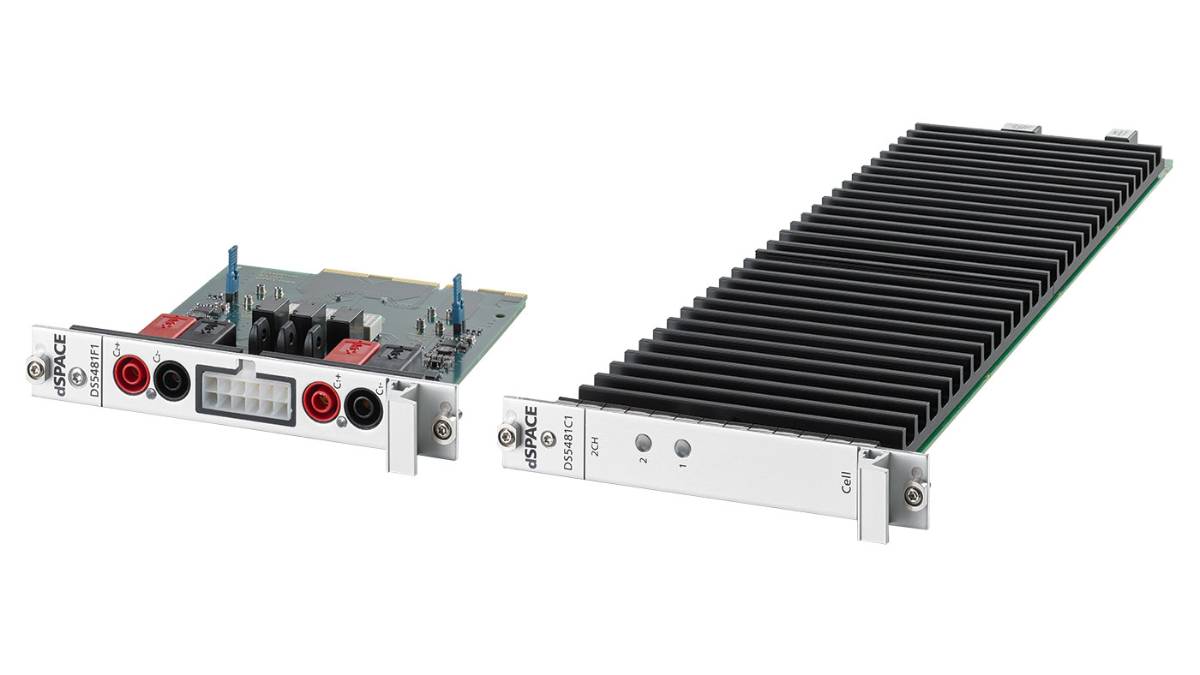
The DS5481 consists of two separate boards: the actual cell emulation board and the failure simulation board.

BMS testing requires the precise emulation of the voltage level of each individual cell of a battery pack. The DS5481 emulates these cell voltages with high precision. The board emulates the terminal voltages for two battery cells connected in series. Multiple boards can be connected in series up to a maximum system voltage of 1,500 V in a HIL system.

The DS5481 consists of two separate boards: the actual cell emulation board and the failure simulation board. Both boards can be easily installed in the existing 19-inch subrack of the SCALEXIO Battery HIL system. It is also possible to operate the DS5481 together with other boards, e.g., the DS5482 4-Channel Cell Voltage Emulation Board, the DS5486 Temperature Simulation Board, or the DS5488 2-Channel High-Voltage Source Board, within a subrack. A dynamic, real-time-capable ASM battery model running on the HIL system controls the boards to ensure a realistic behavior of the simulated battery.

Thanks to the fast and low-latency IOCNET connection to the SCALEXIO real-time system, cell voltages can be updated at rates of up to 20 kHz (processor-based) and up to 100 kHz (FPGA-based). Updating the voltages of all cells takes less than 50 µs for processor-based and less than 10 µs for FPGA-based applications.

In addition, the board can emulate damaged cells, wrong poling of a battery cell, and increased internal resistance of a cell during charging. With the support of high-current cell balancing, integrated high-precision current measurement, and coulomb counting, the DS5481 is the perfect choice for applications requiring the highest performance and precision.

Technical Details

Parameter
Specification1)

Hardware structure

  • 2 cells per board
  • 32 cells per slot unit

Output voltage

  • -6 ... 6 V

Resolution (for 0 ... 6 V output voltage)

  • 10 µV

Resolution (for -6 ... 0 V output voltage)

  • 1.5 mV

Precision2) (for 0 ... 6 V output voltage)

  • ±0.3 mV
Maximum current (sink/source)
  • 20 A (peak)
  • 5 A (continuous)
Isolation
  • 1,500 V between the cells and the environment
Connection
  • IOCNET interface to the SCALEXIO real-time system
Maximum update rate for all cells
  • 20 kHz (processor)
  • 100 kHz (FPGA)
Failure simulation
  • Broken wire between ECU and battery
  • Short circuits of cells
  • High-frequency ripple voltages

1) Preliminary data. For technical specifications, please contact dSPACE.

2) Laboratory conditions.

这听起来很有意思。欢迎沟通交流:

通过 dSPACE时事通讯服务了解最新信息。

通过 dSPACE 时事通讯服务,我们将随时向您通报当前的使用案例、新解决方案和产品以及培训和活动。在此注册,免费订阅。

Enable form call

At this point, an input form from Click Dimensions is integrated. This enables us to process your newsletter subscription. The form is currently hidden due to your privacy settings for our website.

External input form

By activating the input form, you consent to personal data being transmitted to Click Dimensions within the EU, in the USA, Canada or Australia. More on this in our privacy policy.