During flight, ice can form on aircraft when they pass through clouds containing supercooled water droplets. These droplets freeze instantly upon contact with the aircraft surfaces, particularly on the leading edges of wings, engines, and sensors. Ice accumulation alters the aerodynamic characteristics, increases the aircraft weight, and can significantly impair the control, engine performance, and overall flight safety. To mitigate these risks, aircraft are equipped with ice detection and deicing systems. Developing new methods to detect ice formation even earlier and more reliably than before is essential to further enhance aviation safety.
Task: Early and Real-Time Detection of In-Flight Icing Under Extreme Conditions Using a Hybrid Detection Approach
The objective is to detect icing as early as possible, even under challenging environmental conditions, to support timely warnings and appropriate mitigation measures. The reliability and accuracy of ice detection can be significantly increased by an approach that combines direct and indirect ice detection methods into a single system. This approach provides comprehensive information about the aircraft’s state during icing events, including details on icing conditions, ice accumulation, and the remaining aircraft performance and operational capability.
- Direct Detection
Direct detection relies on sensors that measure physical changes caused by ice formation on the aircraft surface. These sensors monitor optical, thermal, electrical, and acoustic (ultrasonic) properties at various locations on the aircraft surface, as these properties change in the presence of ice. - Indirect Detection
Indirect detection does not measure ice directly but instead identifies its effects on aircraft behavior. Ice formation causes characteristic changes, for example, in aircraft performance, control behavior, aerodynamic properties, and energy consumption. By continuously monitoring and analyzing these parameters, indirect detection algorithms can determine the presence and severity of icing conditions.

Figure 1: Hybrid ice detection combines direct and indirect methods. This significantly increases the reliability of ice detection.
Challenge: Seamless Development Process and High Computing Power
The development process of the hybrid ice detection approach follows a six-step process (Figure 2), ranging from system concept to in-flight validation. These steps require a flexible and adaptable development platform with high computational power to meet all performance and operational criteria.
The basic architecture of the hybrid ice detection system is developed during steps one to three. In step four, the algorithms are implemented following a model-based approach. In step five, the code automatically generated from the model is then used on a rapid control prototyping system in the laboratory and, in step six, on the same system for flight testing.
A seamless transition between design, implementation, laboratory testing, and flight testing is critical for efficiency and reliability in the development process.

Figure 2: The six steps development process of the system for hybrid ice detection with the MicroAutoBox III.
Solution: MicroAutoBox III as a Central Computing Component
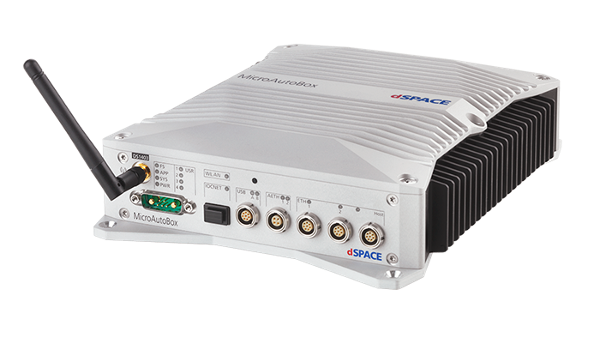
MicroAutoBox III perfectly supports the six-step hybrid ice detection development process (Figure 2) and enables a simple and efficient workflow. It is available in several variants that provide a set of commonly used I/O for various applications. Accordingly, it has been proven across multiple industries as a powerful platform for the rapid implementation of control algorithms developed in modeling tools such as Simulink®.
MicroAutoBox III serves as a compact and robust prototype target platform for the central real-time arbitration computer (Figure 3) of the hybrid ice detection system. Its primary function is to:
- fuse information from direct and indirect detection methods, and
- determine whether an ice warning should be issued.
After initial laboratory testing, the same MicroAutoBox III system can be deployed directly in test flights. Thanks to its high computing power and flexibility, it is capable of executing complex ice detection algorithms in real time, making it a crucial component for the practical implementation.

Figure 3: In its central role as a prototype target platform for the arbitration computer, MicroAutoBox III determines whether an ice warning is issued or not.