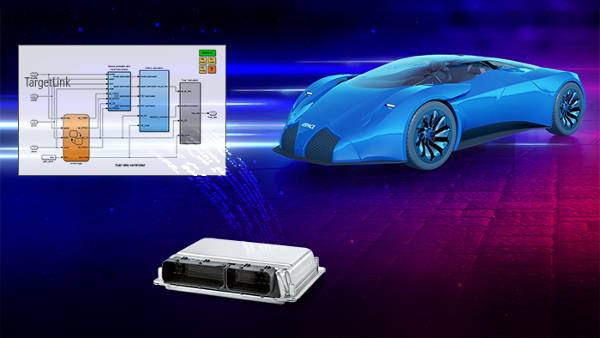
Barracuda, the unmanned aircraft designed by EADS Military Air Systems as a demonstrator and development platform for future unmanned aerial vehicles (UAVs), undertook its maiden flight in San Javier, Spain, on April 2, 2006. Its on-board flight control computer has several subsystems, including the autopilot system, whose code was generated using TargetLink. This UAV demonstrator has enabled EADS to make a quantum leap to the future market of unmanned aircraft, hitherto dominated by the USA.
Why Unmaned Aircraft?
Because they fly autonomously, UAVs have unbeatable advantages over manned aircraft: they save pilots from engaging in risky missions and can undertake extreme flight maneuvers with accelerations which would be too stressful for human pilots. UAVs are also extremely well suited to long and monotonous use, as unlike a human crew they never tire. Due to the high degree of automation, pilot training is unnecessary – simply software updates are all that is needed. UAVs also need no life support systems such as oxygen supply and pres surized cabin. Deployment options for UAVs are mainly in monitoring and reconnaissance, and they can also be inexpensive substitutes for satellites, for example, as transmission stations or for map creation.
Barracuda, fully autonomous in flight (length 8.25 m, wingspan 7.22 m, take-off weight approx. 3 tones), serves as a development platform for unmanned aircraft of the next generation.
- EADS develops Barracuda, the unmanned UAV demonstrator
- Automated production code generation with TargetLink
- 45% of flight control software generated using TargetLink
Barracuda – The Electric Aircraft
The Barracuda does honor to its namesake, a predatory fish that swims with the swiftness of an arrow, consisting as it does of carbon-fiber compound and containing numerous technical refinements that TargetLink helped to develop. Apart from the landing gear and nose-wheel steering, the aircraft is completely electrical, and unlike conventional aircraft, it has electromechanical actuators instead of hydraulic. The triplex redundant flight control computer (FCC) makes the Barracuda extremely reliable. The modular avionics concept of the UAV demonstrator allows a wide variety of systems to be integrated, such as radar, electro-optical or infrared sensors, laser target markers, and detectors for radio-magnetic emitters, to mention just a few. This open and modular avionics system makes it the ideal development platform for future UAVs.

TargetLink for All Algorithms
When designing the software for the flight control computer of the Barracuda, we utilized Simulink® and Stateflow® for developing the model in addition to TargetLink for code generation for the following elements:
- Flight control
- Autopilot
- Flight management
- Air data calculation
- Navigation
- Signal consolidation in the triplex redundant system. The essential signals and state variables are compared with each other and equalized at a frequency of 50 Hz.
More Stringend Than Required
Overall, we generated about 45% of the FCC source code automatically using TargetLink. The hallmark of our process is that the system is designed in Simulink and Stateflow and subsequently the updated models are imported to TargetLink by using a comprehensive script environment. At the start of the project, we often converted new models into code on a daily basis, and after that less frequently. The object code underwent 1-2 days of continuous testing, with subsequent system tests requiring 2-3 days. The EADS philosophy during the entire course of development was to be even more meticulous than would have been required for a maiden flight in closed airspace over a closed zone of the open sea. This means that although we used Level D of certification stan dard RTCA DO-178B for software verification, software design and coding were performed in accordance with DO-178B Level A (the maximum aerospace standard for software certification). This way, we keep our options open for further certification that would enable us to make trial flights with Barracuda at Manching airport.
Pioneering Work for Intelligent UAVs
The Barracuda will help us to perform important pioneering work on the next generation of UAVs. Typical future scenarios for UAVs include combining them with other aircraft or even enabling them to switch from monitoring to reconnaissance automatically.
About the Authors
Dr. Achim Schönhoff and Kai Harth are employed at EADS Deutschland GmbH Military Air Systems, Germany
PUBLISHED IN dSPACE NEWS 3/2006