SIL without Limits: Standardized V-ECUs and AI-Driven Virtualization
- 汽车
- 自动驾驶
- SIL测试
40:08min
概述
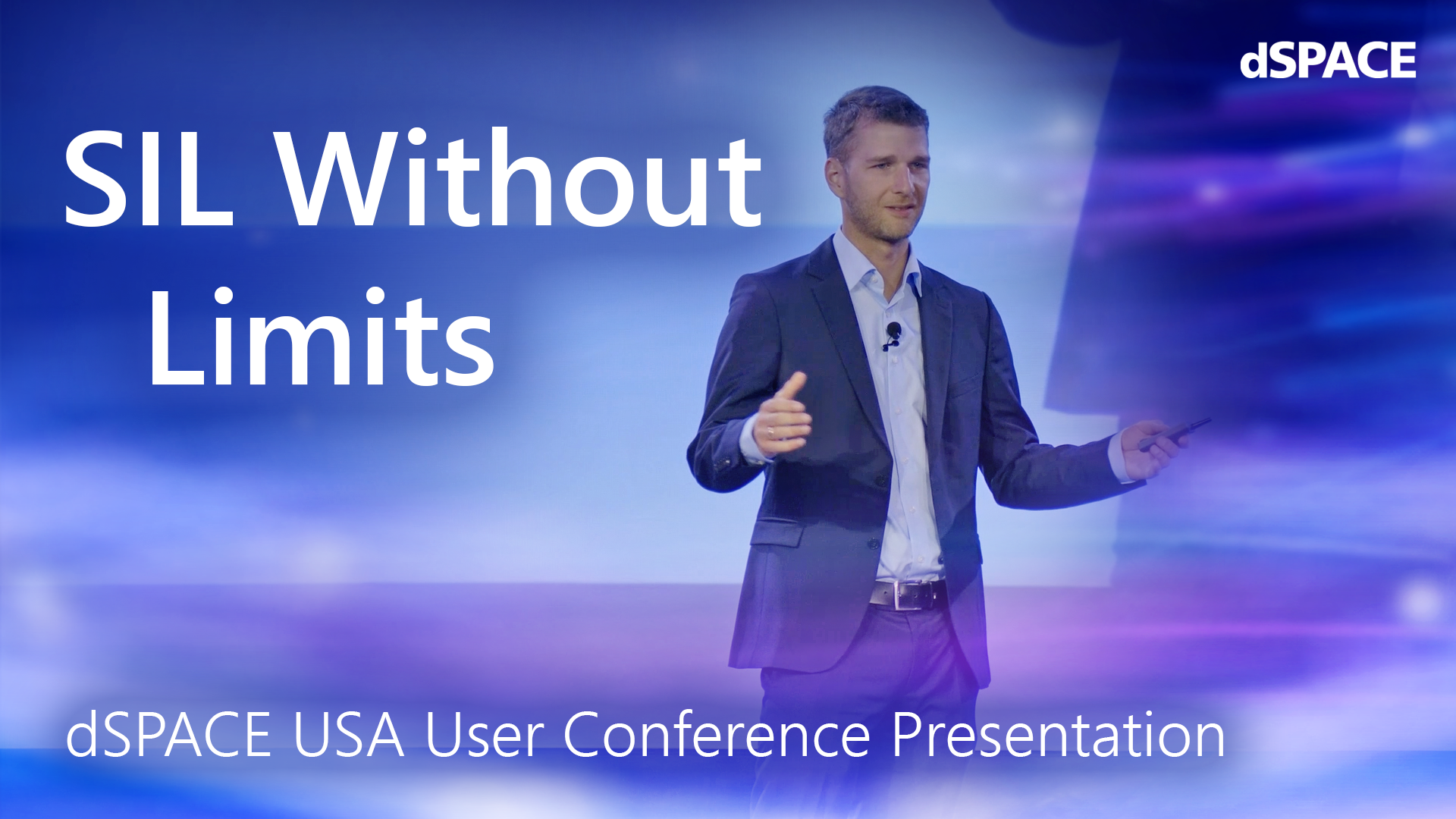
Join Kevin Reim at the dSPACE User Conference 2026 in Michigan for an insightful presentation on how standardized virtual ECUs (V-ECUs) and AI-driven virtualization are transforming Software-in-the-Loop (SIL) development.
As SIL becomes a cornerstone of modern product development, organizations are increasingly requiring virtual artifacts that can be reliably exchanged across suppliers, OEMs, and development teams. Learn how standardized interfaces and communication models enable efficient collaboration and scalable virtual validation workflows.
What you'll learn in this session:
- How AI-powered virtualization enhances SIL workflows
- How the FMI Layered Standard enables standardized exchange and interoperability of virtual ECUs
- Key benefits of reducing hardware dependency for ECU testing
- How AI can automate key virtualization tasks and significantly reduce engineering effort
- Future-proof strategies for software-defined automotive systems
Who should watch:
Engineers, technical leads, architects, and managers at OEMs, Tier-1 suppliers, and software platform organizations involved in ECU development, virtualization, SIL testing, model integration, and virtual artifact exchange.
Watch now to explore how artificial intelligence transforms SIL workflows, speeds up ECU development, and reduces cost through virtualization!
主讲

Kevin Reim
Customer Solution Architect, Automated Driving & Software Solution, dSPACE SE & Co. KG
FAQ
Q1: What does SIL (Software-in-the-Loop) mean in automotive software development?
A1: SIL is a simulation approach that allows developers to test embedded control software on a virtual platform instead of real hardware. This enables early-stage validation, faster iteration cycles, and reduced dependency on physical prototypes in automotive development.
Q2: How does AI-driven virtualization enhance the SIL workflow?
A2: AI-driven virtualization accelerates setup and test execution. Three weeks of manual effort can now been done with AI in a single day. It also improves predictive analysis during SIL simulations, allowing developers to optimize performance and catch system issues before hardware.
Q3: Why are standardized V-ECUs important for combining SIL and AI?
A3: Standardized Virtual Electronic Control Units (V-ECUs) ensure interoperability across tools and platforms in AI-augmented simulation environments. This simplifies model exchange, reduces integration effort, and guarantees scalable testing workflows throughout the development cycle.
Q4: What are the benefits of using SIL combined with AI in automotive verification?
A4: The combination provides early validation of ECU and system behavior under real-world conditions without hardware constraints. It reduces risk, shortens time-to-market, and enables automated optimization of complex control strategies and calibration tasks.
Q5: Can AI-driven SIL testing replace physical prototypes completely?
A5: While AI-driven SIL significantly minimizes the reliance on prototypes, complete elimination is unlikely due to final compliance and physical performance checks. However, it can reduce hardware needs by up to 80%, leading to substantial cost and time savings.
Q6: Who should adopt AI-driven SIL workflows in automotive development?
A6: These workflows benefit OEMs, Tier-1 suppliers, and software engineers aiming to accelerate development cycles while maintaining safety and quality standards. Any team dealing with complex ECU architectures and connected vehicle systems will gain efficiency and scalability through AI-driven SIL.


