As software can be built, modified, and tested in short iterations, it now controls the speed of vehicle development. Waiting for the complete hardware to be available is no longer compatible with this pace. A test strategy is therefore required that enables early system tests, even if real control units (ECUs) are only gradually becoming available.
This is precisely where the SIL-HIL co-simulation comes into play: Software-in-the-loop (SIL) begins with early, scalable tests, while hardware-in-the-loop (HIL) provides real-time validation. Both are seamlessly connected and use the same artifacts without breaks in the tool chain.
What can OEMs and Tier 1s expect from SIL-HIL co-simulation?
OEMs are under increasing pressure to start system testing earlier and earlier – often at a time before all ECUs are even available. At the same time, classic "big bang" integration, in which all ECUs are brought together only at the end, with its typical disadvantages such as late error detection, high integration risk, and causes that are difficult to localize, is hardly practicable today.
For continuous validation, it is crucial that the test environment keeps pace with the maturity level of the components. In reality, however, availability determines the process: What is available now is also being tested now. Early software versions are therefore executed in the SIL system, while hardware ECUs that are already available are tested in parallel in the HIL system.
A consistent SIL-HIL test strategy enables system tests even if only some of the ECUs are available as hardware and other components are still only available as virtual ECUs (V-ECUs). Artifacts, test cases, and simulations are reused consistently and end-to-end between both environments, so that even a single V-ECU is sufficient to bring forward initial integration steps and efficiently support shift-left objectives. SIL-HIL co-simulation combines virtual and real ECUs in a common scenario and creates a seamless validation flow – an approach that speeds up the testing process and prevents teams from having to wait for complete hardware setups.
Furthermore, SIL-HIL co-simulation offers additional benefits that are relevant for both OEMs and Tier 1s: It enables the integration of V-ECUs or models that cannot run natively on the HIL – such as Windows-based or third-party components – into the HIL simulation. This means that such models can also be integrated into the tests regardless of their execution environment.

With SIL-HIL co-simulation, V-ECUs can be progressively replaced by real ECUs, accelerating integration and driving shift-left throughout the development process.
Where does the hybrid test strategy reach its limits?
Of course there are natural limits to seamless co-simulation. In essence, it involves the coupling of two time worlds – HIL runs in real time, while time is simulated in SIL. This is done as if the individual calculations do not consume any time (zero time assumption). This means that SIL can simulate faster, slower, or even approximately in real time – but never in exact real time. Coupling these approaches is feasible, but reaches its technical limits, especially when time constraints are tight.
If high temporal resolution, strict latency budgets, or tight jitter limits are required, the components concerned should run on the same system, either both in SIL or both in HIL. When combining SIL and HIL in hybrid systems, the SIL simulation must run in near real time. Otherwise there is a risk of clock offset, buffer overflows, and unrealistic response times.
Finally, the choice of interfaces also sets the parameters. An interface between SIL and HIL is usually easy to manage with analog/digital signals, CAN, and Ethernet. LIN and FlexRay, on the other hand, are much less suitable for separation, as particularly high time dependencies and strict communication time schemes often have to be observed here.
The Five Most Important Advantages of a Comprehensive SIL-HIL Test Strategy
The comprehensive SIL-HIL test strategy including co-simulation shows its added value in the application: The interplay between the virtual and real test worlds results in five key advantages.
1. Early fault detection
With SIL, functions can be tested even before real hardware is available. This means that faults become visible much earlier and can be rectified before they become expensive or critical in later development phases.
The result: earlier findings, less iteration effort, lower risk
2. Reusable artifacts
SIL artifacts such as restbus configurations, V-ECUs, or automated test cases can be used in both the SIL and HIL systems. This avoids redundant maintenance. The co-simulation efficiently combines both areas.
The result: less adaptation effort, less maintenance, greater consistency
3. Seamless workflows
SIL and HIL are merged into a standardized test workflow. Combined setups of V-ECUs and real ECUs serve as a connecting intermediate step so that the test process is not split into two separate worlds.
The result: one setup, less hardware, faster test procedures
4. Availability-driven tests
Real and virtual ECUs can be freely combined depending on availability. An availability-driven approach makes it possible to start tests regardless of whether real hardware, V-ECUs, or a mixture of both are available. Virtual restbuses supplement missing components and ensure that the tests can continue without waiting times.
The result: maximum flexibility, deeper tests, reduced HIL load
5. Efficiency
SIL offers almost unlimited scalability and can run simulations faster than in real time. This enables extensive parallel regressions without hardware waiting times. HIL also offers real-time accuracy for critical integration phases of complex ECUs.
The result: faster development cycles, lower costs, shorter time-to-market

Modeling tools, simulation artifacts, test cases, and validation solutions can be reused across SIL, HIL, or hybrid platforms, providing the foundation for seamless SIL-HIL validation.
Useful Application Scenarios
An example hybrid scenario is a head unit – i.e., the infotainment ECU of a vehicle – as a device under test in the HIL system, while the rest of the vehicle runs in the SIL system. The head unit communicates in real time with physical interfaces, including the Ethernet backbone and specific I/Os, while the vehicle and environmental logic is provided virtually. In this way, functions, communication, and network traffic can be tested under controlled and reproducible conditions – without having to wait for the complete vehicle hardware to be available.
A setup in which an ADAS/AD high-performance control unit (HPC) is validated with a HIL test system, while the sensor environment, vehicle dynamics, and other ECUs remain in the SIL system, works in the same way. The HPC sees real real-time conditions, but obtains its complex sensor and driving environment from scalable SIL models. The dividing line is where real-time integration validation is crucial, while variant-rich, computationally intensive scenarios can be efficiently mapped virtually.
How SIL-HIL Co-Simulation Looks at dSPACE
Finally, the central question arises: How can such a consistent SIL-HIL approach be realized in practice? This is where dSPACE comes into the game. Our platforms for virtual and real testing are designed so that both worlds can work together synchronously, deterministically, and without breaks in the tool chain.
The setup is as follows:
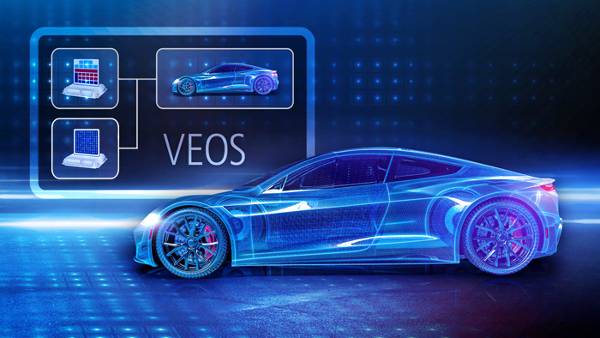
- VEOS handles the execution of V-ECUs and purely SIL-capable models, e.g., compiled for Windows, including virtual signal and bus communication.
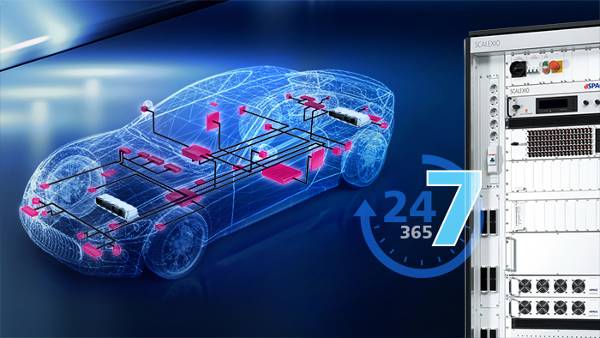
- SCALEXIO simulates real ECUs, bus and network communication, and physical I/Os.
- A coupling bridge connects both systems and continuously exchanges signals, bus frames, and states so that the SIL and HIL sides interact in a time-synchronized manner.
- Restbus and environment models, which can be executed on both platforms, are distributed to VEOS and SCALEXIO in such a way that the timing requirements for communication between VEOS and SCALEXIO are kept to a minimum.
- Test and experimentation tools access VEOS and SCALEXIO and extract or manipulate the relevant data.

End-to-end product support across VEOS (SIL) and SCALEXIO (HIL) through co-simulation, enabling early and continuous validation in virtual and real domains.