
Highly flexible testing of charging communication for all common charging standards around the world, to achieve efficient validation of EV charging components

Various Charging Standards Supported
ISO 15118, DIN 70121, ChaoJi-2, CHAdeMO, GB/T, and NACS

Conformance Testing
Ensure conformance of EVCCs with charging standards

High Degree of Customization
Interfaces for all common charging plugs

Fault Injection Capabilities
Simulation of errors during communication
What is the dSPACE Smart Charging Solution?
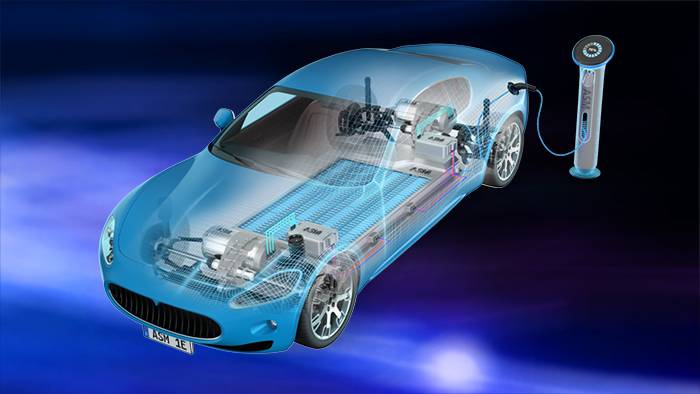
The dSPACE Smart Charging Solution is a key solution for developing and testing technologies involved in the electric vehicle charging process. The combination of hardware and software components offers comprehensive testing options. The solution supports all common charging communication standards and can be easily integrated into your test setup. Thanks to its high flexibility, it can complete a range of tasks.
Get an overview of our equipment for validating charging technologies on this website and learn how your development process will benefit from the comprehensive dSPACE solution.
Application Areas
The Smart Charging Solution supports both manufacturers of electric vehicles and manufacturers of charging stations in developing and testing charging technologies. You can use it for the following:

Validating Onboard Chargers
- Test real electric vehicles and onboard chargers by connecting them to simulated charging stations that support different standards
- Test various ECUs and power electronics components involved in the charging process

Validating Charging Stations
- Test charging station controllers in early development stages thanks to the electric vehicle simulation included in the Smart Charging Interface Software
- Test charging according to all common charging standards on the signal and power level



Key Benefits
The Smart Charging Solution supports you throughout various development steps – from software-in-the-loop (SIL) testing to hardware-in-the-loop (HIL) and power HIL (PHIL) testing all the way up to real-vehicle testing. It comes with a CAN FD interface for easy integration into existing HIL environments.
The solution supports both AC and DC charging. You can also use it to simulate errors during communication and to monitor and manipulate power-line communication used, e.g., for the pairing mechanism (signal level attenuation characterization, SLAC).
Supported Standards
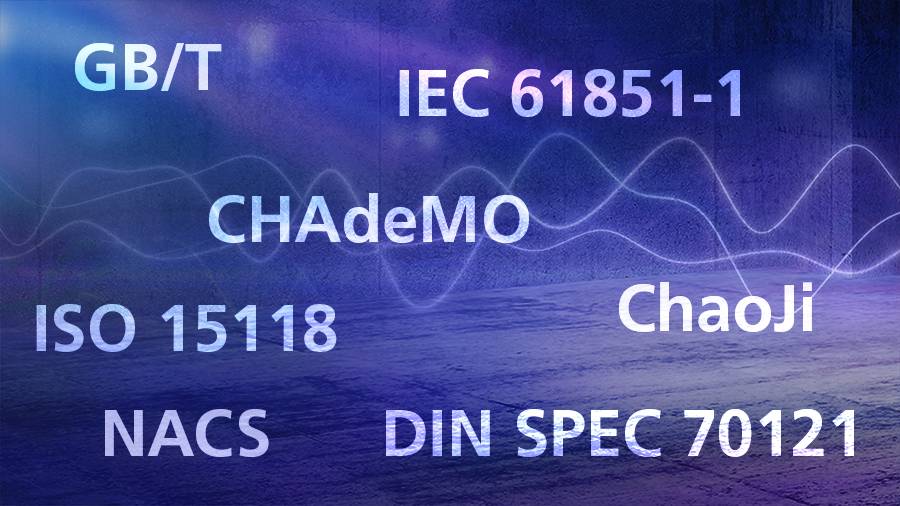
The Smart Charging Solution supports all common standards relevant for charging communication:
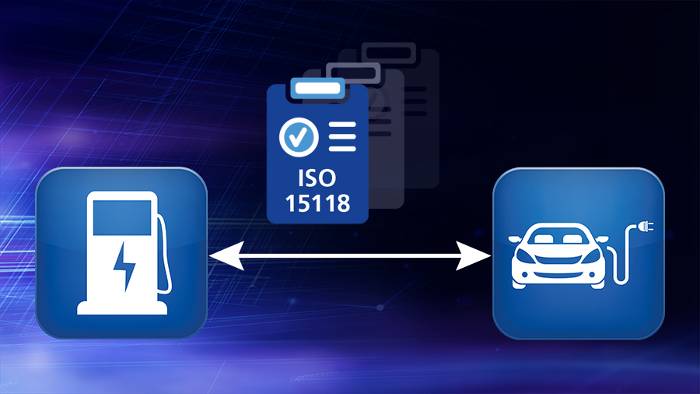
- ISO 15118 and DIN 70121 powerline communication
- IEC 61851-1, ChaoJi-2, CHAdeMO, GB/T, and NACS support
Supported Charging Plugs
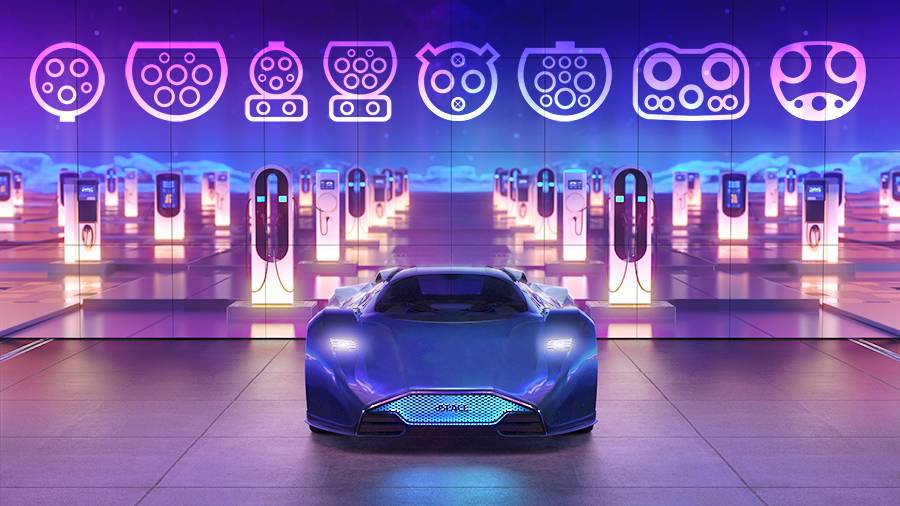
The Smart Charging Solution provides interfaces for all common charging plugs, e.g.:
- Type 1, Type 2, CCS1, and CCS2
- GB/T, CHAdeMO, ChaoJi, and NACS

Conformance Testing
Perform standardized conformance tests to ensure conformance of EVCCs and SECCs1) with charging standards.
Rely on comprehensive dSPACE support including predefined conformance test libraries that comply with global standards, such as ISO 15118-4 or DIN 70121.
- EVCC: Electric vehicle communication controller
- SECC: Supply equipment communication controller
1) Available in a later Release.

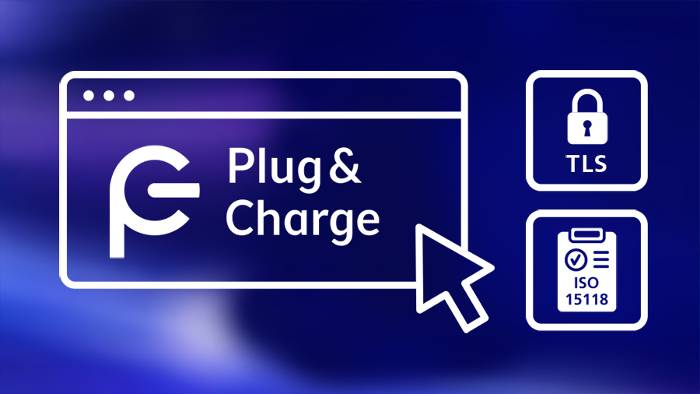
Plug-and-Charge Features
Benefit from the solution's plug-and-charge standard support to achieve secure TLS-encrypted communication.
- Testing advanced features based on the ISO 15118-2 charging communication standard, including plug-and-charge (PnC) and value-added services (VAS)
- Support for transport layer security (TLS) encryption and key and certificate handling

Testing Real Charging Processes
Test real electric vehicles and their charging-related components with the SCALEXIO Smart Charging Power HIL EV Tester.
- Complex field tests in the laboratory
- AC and DC charging for real electric vehicles
- Full simulation of freely configurable charging stations, including grid emulation option
Hardware
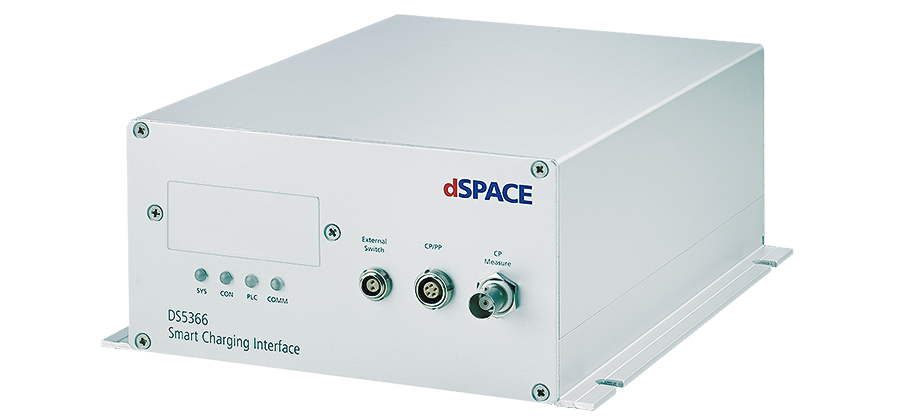
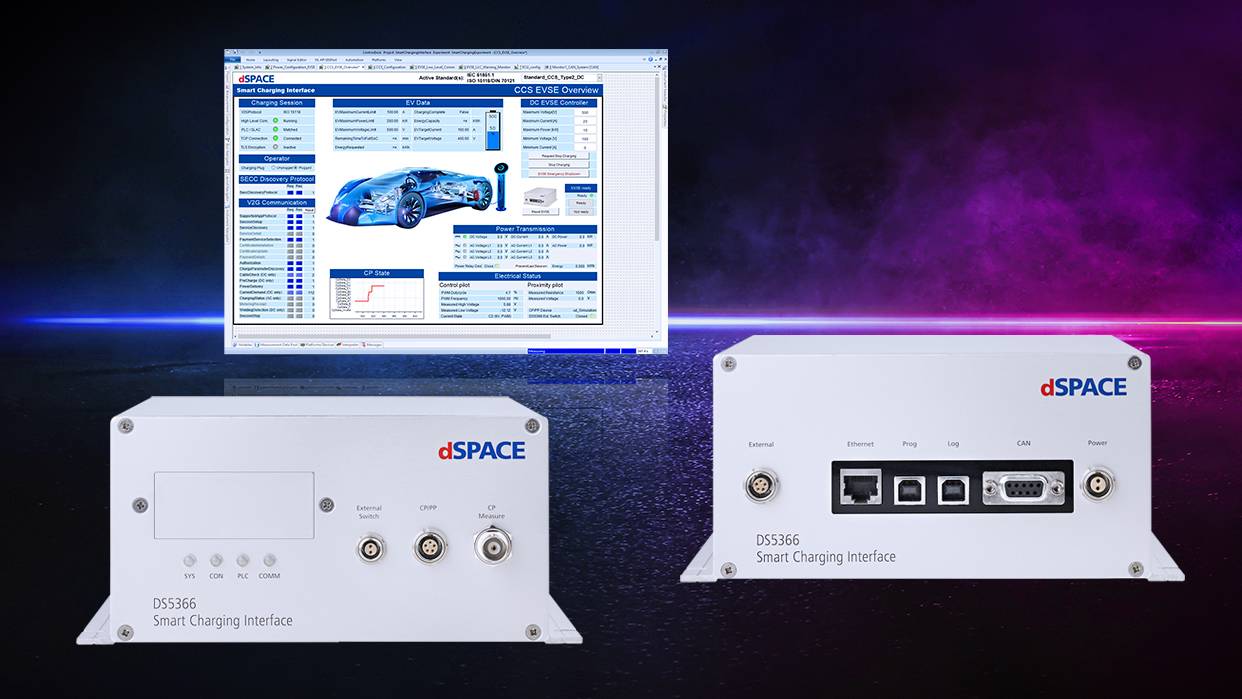
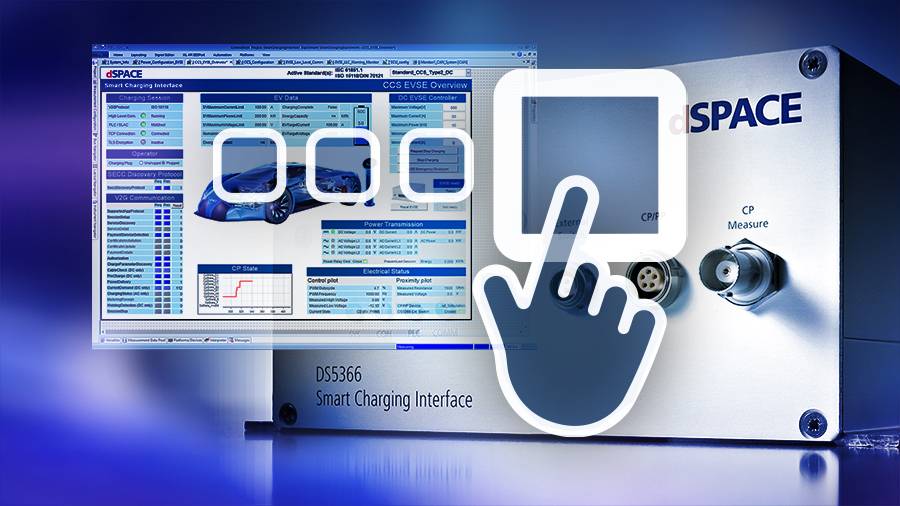
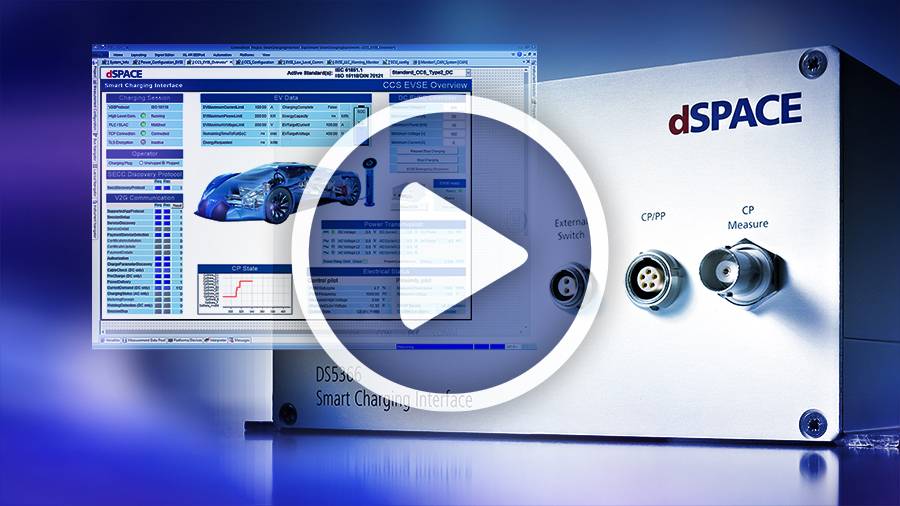
DS5366 Smart Charging Interface
The hardware component of the Smart Charging Solution comes as an interface unit between the hardware-in-the-loop (HIL) simulator and the electronic control unit (ECU).
It provides a CAN FD interface for connecting to the HIL simulator as well as a USB interface for data logging and an Ethernet interface for protocol tracing.
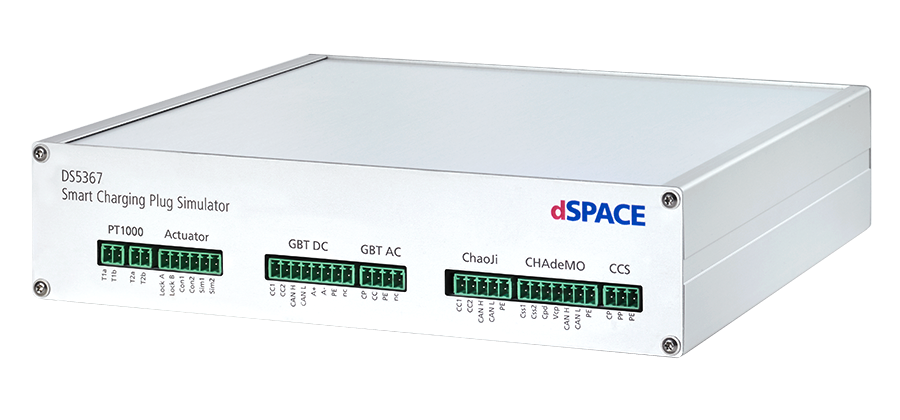
DS5367 Smart Charging Plug Simulator
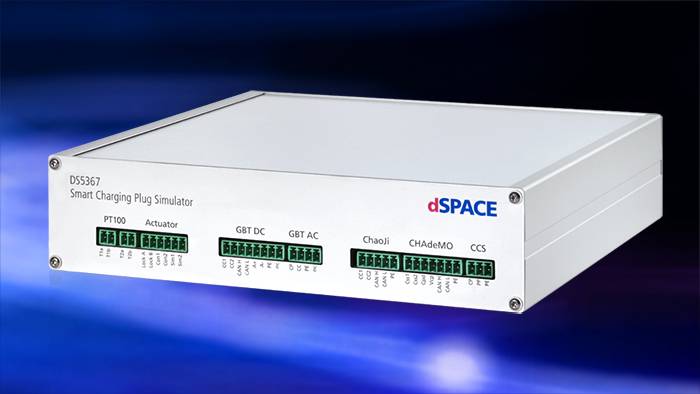
For a comprehensive set of fault insertion options, the DS5367 Smart Charging Plug Simulator can be added to the Smart Charging Solution. It supports all common charging standards.
The extension lets you emulate and manipulate the electrical networks related to connectors, cables, and communication signals and fulfills the CharIN CCS Test System (CCTS) recommendation.
For testing charging stations, the DS5367 Smart Charging Plug Simulator is mandatory.
Technical Details: DS5366 Smart Charging Interface
Parameter |
Specification |
|---|---|
|
Memory |
|
|
Host interface |
|
|
Target interface |
|
|
CAN FD interface |
|
|
Size (width x height x depth) |
|
|
Mass |
|
|
Power supply |
|
Software
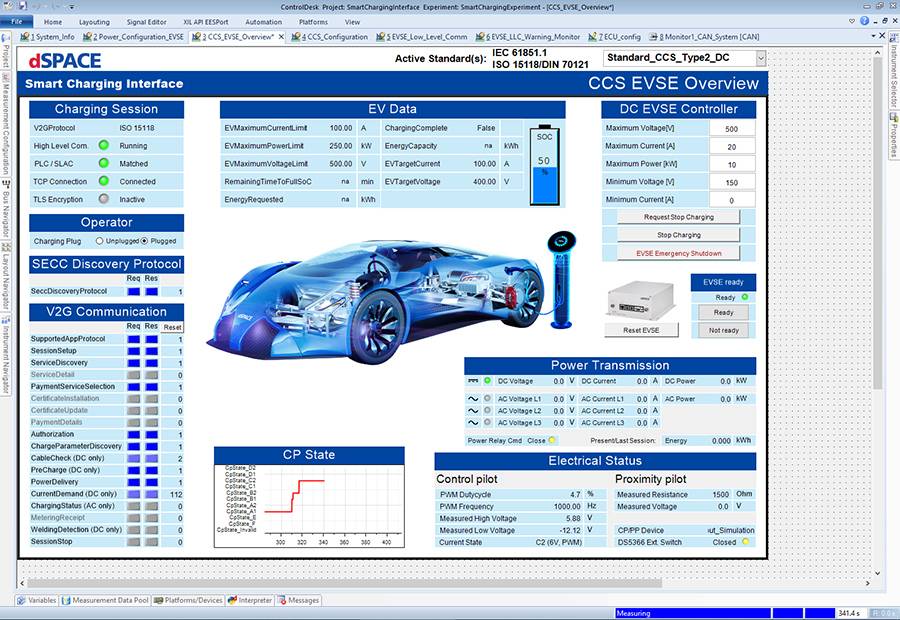
Smart Charging Interface Software
The basic software component of the Smart Charging Solution includes a Simulink® model, ControlDesk layouts, and a DBC file that describes the CAN FD communication.
The Simulink model supports all common charging communication standards, such as ISO 15118, DIN SPEC 70121, CHAdeMO, ChaoJi-2, and GB/T. It includes a user interface for parametrization and allows for the connection and simulation of power electronics components.
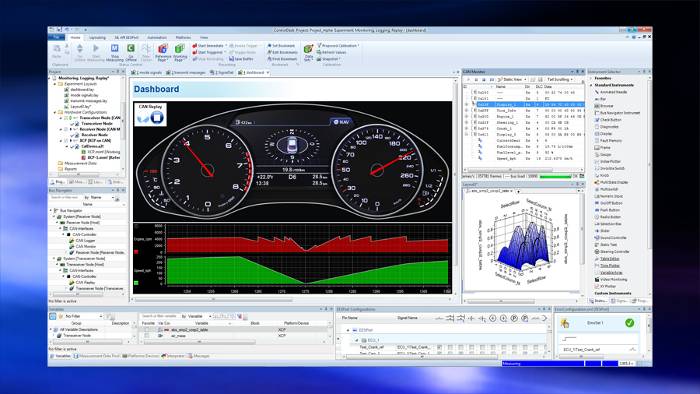
By using the ControlDesk layouts, you gain an overview of all the relevant electrical information, the messages involved in the charging communication, and the communication status. You can also use the layout for configuration purposes, for example, for parametrization as well as electrical and timing manipulation.

Smart Charging PlugAndCharge Software Module
The Smart Charging PlugAndCharge Software Module lets you test advanced features as described in the ISO 15118-2 charging communication standard, including plug-and-charge (PnC) and value-added services (VAS).
These features require TLS encryption and certificate handling, which are both supported by the dSPACE test solution. For certificate handling, dSPACE offers a customizable, ready-to-use dSPACE public key infrastructure (PKI) and supports working with the non-productive PKI from Hubject.
Functionality Overview: Smart Charging Interface Software
Functionality |
Description |
|---|---|
|
Simulink model |
|
|
ControlDesk layouts |
|
|
Manipulation Mode |
|


Simplified Workflow for Using the Smart Charging Solution
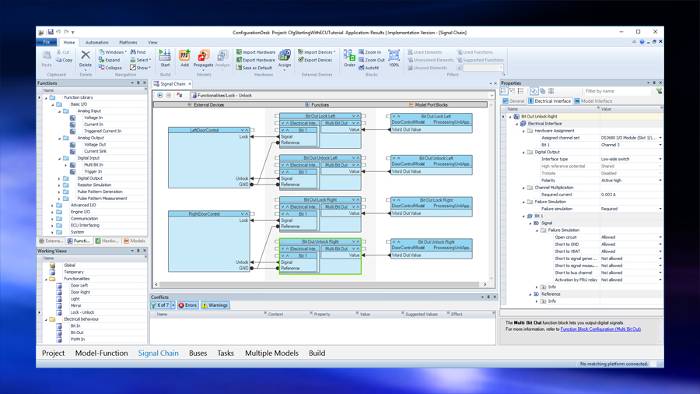
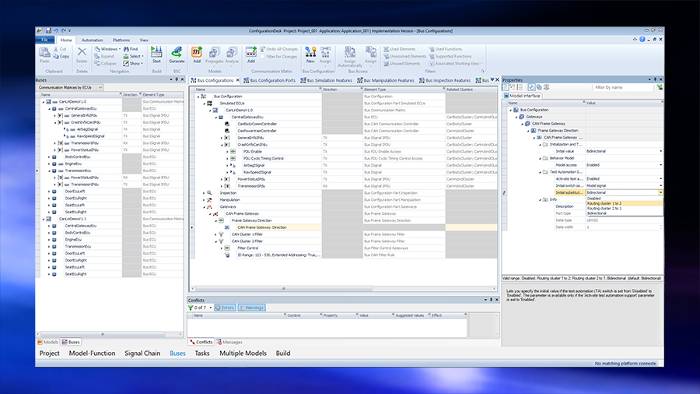
- Open the predefined ConfigurationDesk project and implement your I/O configuration according to your SCALEXIO-based hardware system
- Load your configuration onto the test platform
- Run your simulation and tests and keep track of the results
Required Products
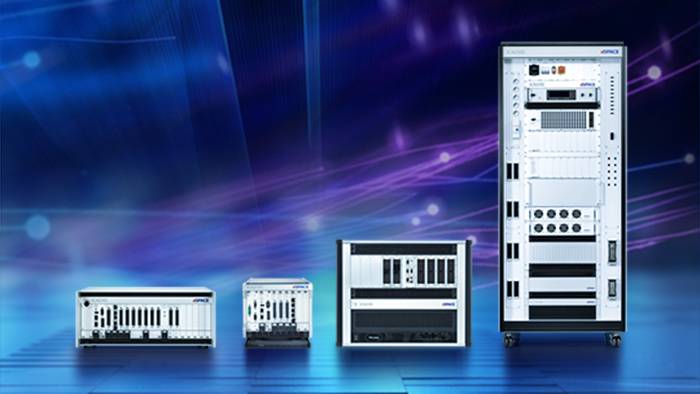
Optional Products
Support for Users of the Smart Charging Solution
Links to detailed technical information and customer service. Access may require registration.