Testing NCAP scenarios − automated and efficient
- Automobile
- Systèmes avancés d’aide à la conduite
- Tests HIL
- Conduite autonome
- Tests SIL
06:44min
Aperçu
Developing Euro NCAP-compliant test scenarios is a real challenge for OEMs and their suppliers: Countless parameter variations, complex target trajectories, and precisely defined collision conditions make the creation and validation of these scenarios a time-consuming and demanding process. Instead of laboriously developing and continuously maintaining scenarios by hand, the dSPACE NCAP scenario database can be imported and executed directly in ASM Traffic using an automated Python workflow. This leaves more time for the essentials: evaluating and validating your own ADAS functions.
The video uses the example of a cyclist crossing scenario (CBNA) to illustrate the entire workflow: starting with the precise, mathematical synchronization of the ego-vehicle and target object, through the automated parameterization and execution of the scenario, to the detailed evaluation of results in SIL and HIL environments. It demonstrates how automated execution, repeatability, and comprehensive reporting enable development teams to evaluate the performance of an ADAS safety function quickly, consistently, and reliably.
Hôtes

Youssef Badawi
Project Engineer Testing & Data Management, dSPACE

Lars Kumutat
Senior Application Engineer - Automated Driving & Software Solutions, dSPACE
FAQ
Q1: What is shown in the video "NCAP scenario tests automated and efficient"?
A1: The video provides a practical demonstration of how OEMs and their suppliers can efficiently test and validate NCAP scenarios using a ready-to-use scenario database and automated, Python-based workflows in dSPACE tools.
Q2: Why is the creation of NCAP scenarios a particular challenge?
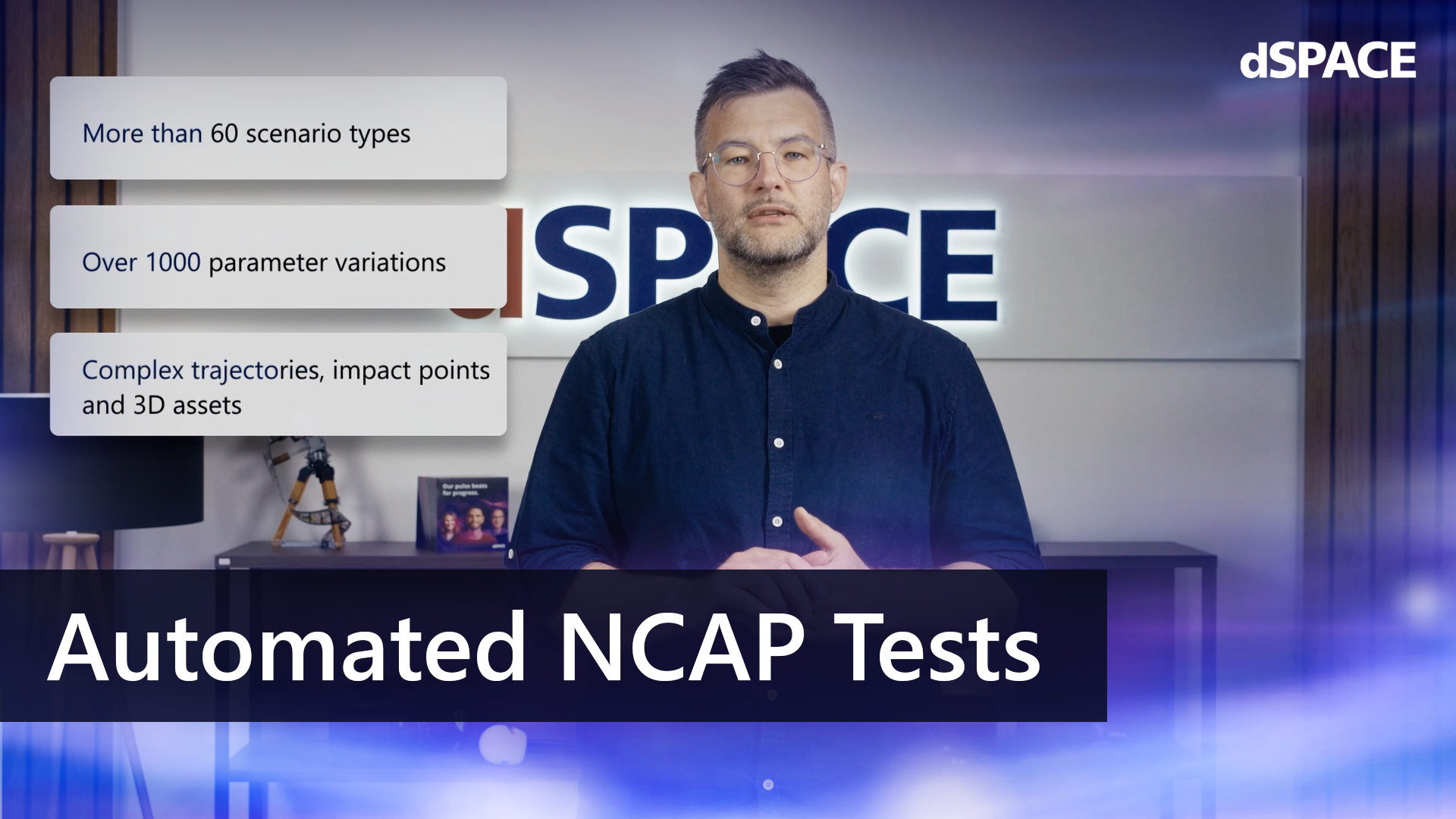
A2: The development of NCAP scenarios poses major challenges for OEMs and their suppliers: More than 60 different scenario types, over 1,000 parameter variations as well as complex target trajectories and precisely defined collision points must be covered. The manual implementation of the NCAP specifications therefore requires considerable development effort, which makes the process time-consuming and error-prone.
Q3: How does dSPACE support NCAP-compliant virtual tests?
A3: dSPACE facilitates the implementation of NCAP-compliant virtual tests with a comprehensive, ready-to-use NCAP scenario database.
Q4: How are concrete NCAP test scenarios generated from logical definitions?
A4: Concrete NCAP test scenarios are automatically generated from logical definitions: Python scripts calculate timing, trigger distances, and trajectories according to Euro NCAP rules. This results in a synchronized behavior of the ego-vehicle and target at the precisely defined collision point − for reproducible, standard-compliant tests.
Q5: Can the demonstrated NCAP test workflow be used for SIL and HIL tests?
A5: Yes, the automated workflow supports both software-in-the-loop (SIL) and hardware-in-the-loop (HIL) environments.
Q6: How are the test results evaluated and documented in this workflow?
A6: Each test execution leads to a detailed report that documents all steps from scenario parameterization to captured signals and results (pass/fail). The report presents collision points, timing, and the activation behavior of an ADAS function transparently and thus supports a comprehensible root cause analysis.
Q7: For whom is the video "HandsOn: NCAP scenario tests automated and efficient" particularly relevant?
A7: The video is aimed in particular at development and test departments for ADAS functions. It offers a practical insight into the creation and implementation of NCAP-compliant virtual tests.