Neural Net Coder reliably converts neural networks into verifiable C code, preparing AI for use in safety-critical, resource-constrained embedded applications.

Production-Ready Code
Generate deterministic, standards-compliant C code from neural networks and apply embedded-specific optimizations.

Post-Training Optimization
Optimize the generated code to reduce resource usage and run time – without retraining the neural network.

Built-In Verification
Compare the generated code with the original neural network using back‑to‑back tests.

Predictable Resource Usage
Estimate run-time performance and memory usage early.
What is Neural Net Coder?
Neural Net Coder generates C code directly from trained neural networks. It uses the ONNX file format, a common standard for saving AI models. This allows neural networks trained in a wide range of frameworks and environments (PyTorch, Keras, etc.) to be used for embedded deployment on various hardware platforms. As a result, you stay flexible, regardless of the AI tools or hardware you use.
The generated code is ready for integration into embedded systems and can be used in C and C++ projects. This enables the use of neural networks in safety-critical, resource-constrained applications.
Neural Net Coder can be integrated into model-based development (MBD) environments, such as TargetLink, and used within existing code-based workflows – from fully automated pipelines via application programming interfaces (APIs) to interactive use through a graphical user interface (GUI).
Neural Net Coder will be available from mid‑November 2026.
Pre-order now!

Built for AI in Embedded Systems
One major application of embedded AI is the realization of virtual sensors, also known as soft sensors. These sensors enable the estimation of physical quantities that are difficult, expensive, or impossible to measure directly – such as internal battery states, tire pressure, or shaft torque. By replacing or augmenting physical hardware with AI-based software, virtual sensors can reduce cost and complexity while enabling predictive capabilities.
However, their implementation must meet the specific demands of embedded systems. In addition to safety requirements, these include strict constraints on determinism, performance, and memory usage. As a result, neural networks deployed in embedded environments must operate reliably under tight resource and real-time constraints.
Neural Net Coder converts neural networks into deterministic C code for embedded systems. It complements code generation with post-training optimization, verification, and resource estimation. This enables developers to ensure that models function correctly within available resources and to balance memory consumption, execution speed, and model accuracy – bringing AI into embedded systems in a controlled and verifiable way.

Key Features
Unlocking the full potential of neural networks in embedded applications requires tools that are robust, efficient, and easy to use. Neural Net Coder rises to this challenge by offering an advanced solution tailored for seamless code generation. Discover how its key features can streamline your workflow and accelerate innovation in safety-critical environments:
Production-Ready Code
Neural Net Coder translates ONNX neural networks into deterministic C code that integrates seamlessly into established embedded tool chains and can be verified using standard software testing and analysis methods.
The generated code is MISRA-compliant and provides predictable run-time behavior, while supporting static memory usage and controlled execution – key requirements for safety-critical embedded applications with strict resource constraints.
Post-Training Optimization
Neural Net Coder supports post-training optimization, which reduces the resource footprint of neural networks on embedded systems without requiring retraining. These optimizations focus on the generated C code, enabling trained models to adapt to the constraints of embedded targets.
By optionally reducing memory usage and computational demands, post-training optimization balances model accuracy and resource efficiency, potentially at the cost of a small loss in accuracy. The integrated verification capabilities allow this trade-off to be evaluated directly. This enables trained neural networks to be adapted for deployment on resource-constrained embedded hardware.
Built-In Verification
Built-in verification compares the functional behavior of the generated C code with that of the original trained neural network. Back-to-back testing of the reference model and the generated code establishes traceability and confidence, supporting model-in-the-loop (MIL) and software-in-the-loop (SIL) verification workflows.
This verification approach is particularly relevant for safety-related applications that use neural networks to supplement or replace traditional algorithms. In this context, built-in verification supports the workflow steps outlined in ISO/PAS 8800, a standard that addresses the safe use of artificial intelligence in embedded and automotive systems. For automotive applications, these verification workflows align with the functional safety processes defined in ISO 26262.
Predictable Resource Usage
Neural Net Coder enables early estimation of run-time performance and memory usage, addressing a key challenge in deploying neural networks on embedded systems. This reduces the risk of integration issues and prevents late-stage design changes caused by unexpected resource constraints. As a result, development teams can make informed decisions earlier in the process, which significantly reduces unnecessary iterations and helps shorten development cycles.
Integration into TargetLink Workflows
Neural Net Coder can be integrated into TargetLink-based development workflows via a dedicated, fully configured block. The generated C code can be used within TargetLink models in a black-box manner, enabling simulation of complete functions, including neural networks. Built-in support for MIL, SIL, and PIL comparisons allows for immediate verification of functions that include the neural network.
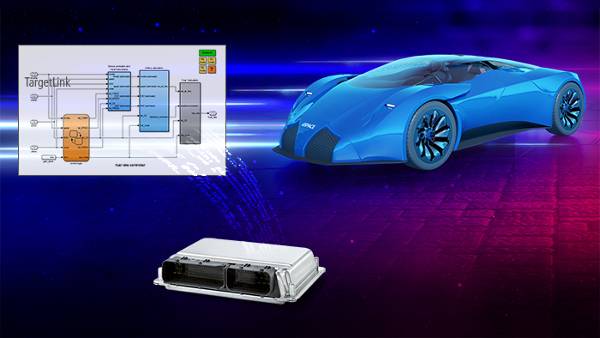
Code Is Key for AI on ECUs
Learn more about why code generation is crucial for reliably deploying small neural networks on ECUs, ensuring that safety and security requirements are met while seamlessly integrating into established automotive development tool chains.

Curious to find out more?
We would be happy to offer you an interactive session with our Neural Net Coder experts, where we address your questions in depth, exchange technical insights, and discuss your specific use case. This provides you with tailored insights aligned precisely with your needs.