ECU Interfacing Made Easy with Binary Code Management
- Automotives
02:07min

Overview
What if you could test or replace ECU-internal functions - without access to the source code?
In this dBRIEF, dSPACE demonstrates how binary code management significantly simplifies the testing and development of functions on production ECUs.
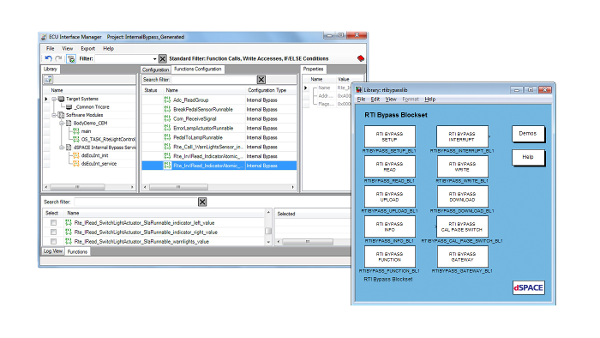
The dSPACE Binary Code Management tool is an efficient tool that allows engineers to modify and test ECU functions without having to access or modify the original source code. This is usually difficult to achieve because tool chains are complex and source code is often only available to a limited extent. The dSPACE solution addresses this key challenge in embedded software development by making adjustments directly in the binary code.
Using only the original flash file and the associated MAP file, the Binary Code Management Tool enables developers to patch unused memory in the ECU software. This approach allows them to access existing functions patch new functions to the flash file without having to modify the source code.
During function development, both external and internal bypassing can be utilized. With external bypassing, the ECU is directly connected to external real-time platforms for rapid prototyping, while internal bypassing stores new functions directly in the ECU memory and executes them within the control unit. During the validation and testing of functions, internal functions can be directly stimulated and the outputs read. This is particularly essential for analyzing safety-critical applications.
The Binary Code Management Tool accelerates development, simplifies testing, and reduces dependence on tool chains and source code availability, making it extremely relevant for development engineers and validation teams.
Hosts

Martin Teiner
Product Manager, Real-Time Test & Development Solutions, dSPACE
FAQ
Q1: What is meant by binary code management in ECU development?
A1: Binary code management is a method that allows ECU functionality to be modified and extended by inserting patches into the compiled software without needing access to the source code. This process utilizes existing flash files and memory mapping information. This enables efficient testing and rapid iterations.
Q2: How can ECU functions be modified without source code?
A2: Functions can be modified by inserting patches into unused memory areas of the ECU software. This eliminates the need for recompilation and direct changes to the source code. Using information from the MAP file, free memory areas can be identified, and patches can be linked to existing function entry points.
Q3: What is the difference between internal and external bypassing?
A3: With internal bypassing, new functions are stored directly in the ECU memory and executed within the control unit. With external bypassing, functions are executed on an external real-time platform connected to the ECU. Both methods support flexible testing and development.
Q4: What are the advantages of using binary code management?
A4: It reduces dependence on tool chains and access rights to source files, accelerates development cycles, and simplifies ECU testing. These changes lead to more efficient and flexible workflows.
Q5: Why is response time analysis important when testing ECUs?
A5: Response time analysis ensures that the ECU’s functions meet performance and safety requirements. This is particularly critical for safety-critical vehicle systems. Accurate time measurement helps validate system reliability.
Q6: What inputs are required to use the Binary Code Management tool?
A6: The tool requires the original ECU flash file and a MAP file that describes the memory layout and function entry points. These inputs enable the precise insertion of patches. No additional source code is required.