SIL-HIL Co-Simulation: Test Together, Develop Faster, Reduce Risks
- 첨단운전자보조시스템(ADAS)
- HIL Testing
- 자율주행
- SIL Testing
05:11min
개요
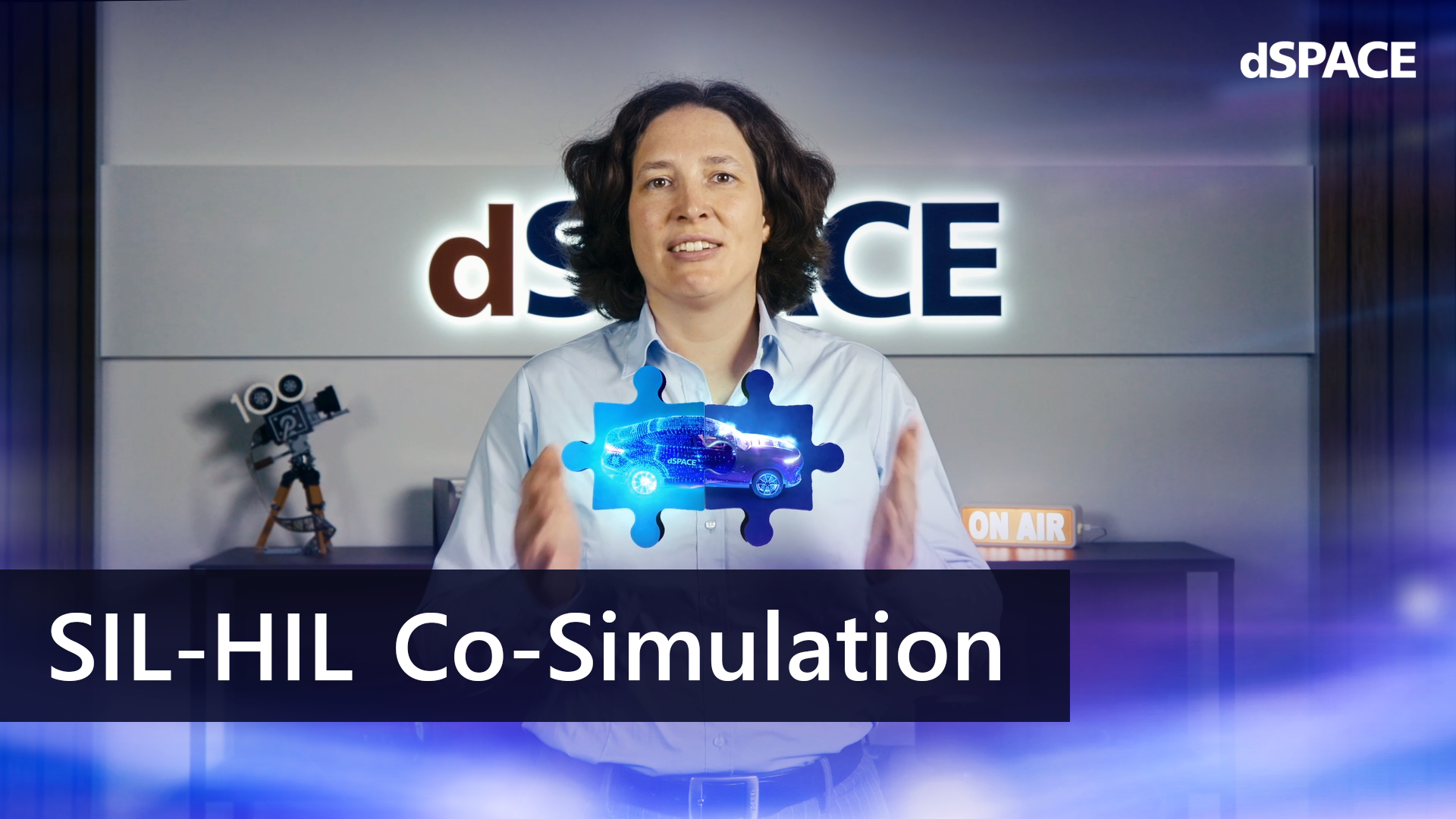
What if software-in-the-loop (SIL) and hardware-in-the-loop (HIL) testing were no longer separate domains, but could be used together as early as in the initial development phases? Continuous, low-risk testing would minimize risks and significantly increase efficiency.
With dSPACE SIL-HIL co-simulation, this becomes a reality: It creates a unified test environment in which SIL and HIL work together seamlessly from the very beginning. Development artifacts can be reused throughout the process, tests can be expanded step by step, and they can be integrated with one another at an early stage. This reduces integration risks, detects errors earlier, and accelerates development processes overall – for higher quality with lower time and cost expenditures.
With SIL-HIL co-simulation, developers test virtual and physical components at the same time, enabling earlier integration tests and greater realism. Existing SIL models and test cases can be directly integrated, reducing duplication of effort and maintenance costs. Continuous testing is possible, from algorithm development through to full validation of the ECU network, which shortens development time and increases confidence in the results.
At the heart of this approach is the hybrid simulation integration layer (HSIL), which connects SIL and HIL environments via the DDS protocol. It supports signal-based, CAN, and Ethernet communication, ensuring compatibility even between different simulators. The result is a flexible, scalable, and efficient simulation environment that significantly reduces rework and accelerates time to market.
강연자

Steffen Luis
Field Application Engineer, dSPACE

Barbara Kempkes
Business Field Manager, dSPACE SE & Co. KG
FAQ
Q1: What is dSPACE SIL-HIL Co-simulation?
A1: SIL-HIL co-simulation is an approach that combines software-in-the-loop (SIL) and hardware-in-the-loop (HIL) testing in a single, end-to-end environment. This allows virtual and physical components to be validated together, even in the initial development phases.
Q2: What problem does SIL-HIL co-simulation solve?
A2: It overcomes the traditional separation of SIL and HIL, which often leads to integration problems in later process phases. Through early integration, errors are detected sooner, risks are reduced, and time and cost expenditures are significantly lowered.
Full simulation is also possible even if individual artifacts are available exclusively for SIL or exclusively for HIL. This means that the artifacts do not have to be laboriously created or requested for the other platform. Instead, they can be flexibly combined and tested together.
Q3: How does the solution support continuous testing?
A3: Co-simulation enables end-to-end testing from algorithm development through to the complete validation of the ECU network. Existing models and test cases can be reused and gradually expanded, resulting in a continuous and efficient testing process.
Q4: What role does the hybrid simulation integration layer (HSIL) play?
A4: HSIL forms the technical foundation of integration: It connects SIL and HIL environments via DDS and supports signal-based, CAN, and Ethernet communication. This enables flexible, scalable, and cross-simulator coupling.
Q5: Which simulators are supported?
A5: VEOS and SCALEXIO support HSIL directly. In addition, thanks to HSIL's open architecture, other simulators can also be integrated.
Q6: What are the specific benefits for verification?
A6: Verification benefits from early integration testing, greater realism, and improved reusability of test artifacts. This reduces duplication of effort, lowers maintenance costs, and accelerates development while simultaneously improving quality and increasing confidence in the results.


