Automotive development is undergoing a profound transformation. Validating new vehicles is becoming increasingly complex, and development cycles are getting dramatically shorter, all while cost pressures are rising. This raises a key question for OEMs: How can they reliably implement increasingly complex validation processes in ever-shorter time frames, while working with limited or unchanged resources?
Ford Relies on Automation, Reusability, and a Tool Chain from dSPACE
Ford Werke GmbH in Cologne has found a clear answer to this question: The company is now relying on a highly scalable, data-driven HIL architecture that is based on automation, reusability, and a tool chain from dSPACE.
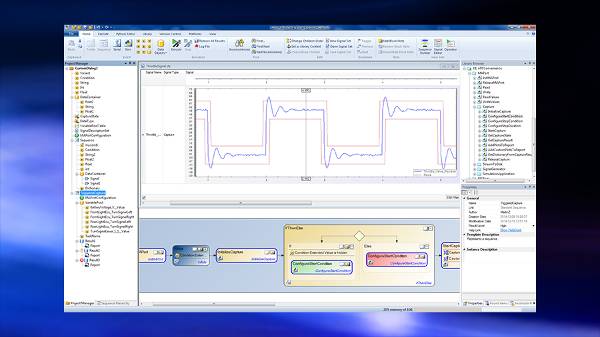
This architecture is based on SYNECT, AutomationDesk, ConfigurationDesk, and the SCALEXIO HIL system. Embedded in an end-to-end CI/CD/CT pipeline, an environment is being created that processes new model versions 24/7, automatically simulates variants, and orchestrates test sequences without manual intervention.

At Ford, an automated HIL architecture based on SYNECT, AutomationDesk, ConfigurationDesk, and SCALEXIO enables continuous 24/7 validation of new model versions.
A Future-Proof Basis: The Modular HIL Architecture
It is already clear at first glance: Ford's HIL department in Cologne is not focusing on small steps, but has strategically realigned its entire HIL landscape. A central component of this change was the introduction of SYNECT as a data and process platform.
SYNECT enables a hierarchically structured model variant that consistently links model versions, tests, and configurations. This ensures transparency, avoids duplication of work, and creates reliable process chains across teams and development phases.
The hardware also follows this modular approach. SCALEXIO systems and specialized racks for engine, steering, braking, or transmission can be flexibly combined without increasing the number of HIL systems to the same extent – a great advantage when variants come and go at ever shorter intervals.
In addition to clearly defined responsibilities of the individual specialist groups, the degree of complexity of the test environment can be flexibly adapted to the respective test requirements. This makes test processes more efficient, avoids unnecessary effort, and achieves exactly the validation that is actually needed without increasing the number of HIL systems to the same extent.

Ford is responding to the sharp increase in test variants with a new approach that ensures the efficient use of existing HIL systems.
Modular Simulink Models: How Ford Is Scaling Its Variant Management
One key challenge was to reflect the growing number of drive and vehicle variants in the models. Ford decided to break down large monolithic Simulink models into modular units (Simulink implementation containers, SIC).
All models are managed in Git, follow standardized structural rules, and use a common interface library that consistently defines all signals in JSON files.
Similarly all components, including SICs, bus simulation container, and working views, are centrally managed in Git, together with all variant-specific information. The actual build process runs automatically: ConfigurationDesk assembles the required components on the basis of the variant model, recognizes the necessary dependencies, and generates the real-time application. Overnight builds test new model versions and release them automatically, a process that previously took days or weeks.

Application Build Pipeline: From generic submodels (slx) through a component library (sic, bsc, …) to a variant-specific real-time application (rta)
Signal Management as the Key to Stable, Reliable Tests
With a wealth of variants and dynamic model changes, stable testing is not a given. Ford addresses this problem with a highly automated XIL API mapping according to ASAM standard.
Ford is aiming for complete control over the signal interface. Signal names are defined centrally in the SYNECT database, configured per variant, and then integrated semi-automatically into the models. This is done with the help of a specially developed SYNECT extension. All mappings are generated automatically overnight and can be used directly in the test processes. This means that testers always work with the correct signals, regardless of how many model changes were made the day before.
This approach clearly separates models, hardware, and test definitions. The result: Tests remain portable, reproducible, and robust, even if the model version changes daily.

XIL API mapping is at the heart of signal management. This is managed centrally using a SYNECT extension developed specifically for Ford.
Automated HIL Workflows for Every Variant
To ensure that each vehicle variant runs correctly on the simulator, it undergoes a fully automated setup. This configures all relevant elements: platform, parameters, ECU settings, and the associated ControlDesk and ModelDesk projects.
At the same time, metadata is automatically recorded to facilitate subsequent comparisons and audits. Traceability, which used to be a manual effort, is now fully automated by the process. The result: faster preparation, greater test stability, and consistent quality across all variants.
Keyword-Based Test Automation: Stable Over Generations
Another crucial component is the way Ford describes tests. Instead of creating separate test procedures for each variant, the company works with a semantic, extremely abstract, keyword-based methodology.
Tests are described with the help of clearly defined semantic building blocks. These modules and the complete test definitions are created in Ford's own software and then imported seamlessly into SYNECT. Each of these modules is implemented in AutomationDesk.
The consistent separation of implementation and parameterization forms the basis for stable and scalable test automation. Almost all test and variant-specific adjustments are made exclusively via parameterization. This reduces complexity, increases robustness, and enables efficient reuse across different variants and test scenarios.
This principle makes both the test definitions and the test implementations extremely durable. This allows for cross-platform support of many vehicle models without the need to modify core structures.
Everything is controlled centrally via SYNECT Test Management, which handles the configuration, execution, and management of all artifacts. Here too, Ford-specific SYNECT extensions support the user.

Test content can be configured centrally in SYNECT (Build Configuration, Framework Configuration). Here, too, SYNECT extensions developed specifically for Ford come into play. This ensures that the test, parameterization/configuration, model, and HIL are perfectly aligned even before the test is run.
On the Way to a Comprehensive CI/CD/CT Landscape
The new architecture has created the foundation not only for automating tests, but also for making them part of a fully integrated, continuous development process.
To further increase efficiency, Ford now plans to extend the clear separation of test execution and evaluation, as well as the existing HIL infrastructure, to SIL scenarios. This brings end-to-end validation within reach, in which functional development, variant management, and automated testing are seamlessly integrated.

Ford's new architecture combines functional development, variant management, and automated testing into a seamless end-to-end validation process.
Short interview with Stefan Hengstmann
Why does Ford rely on a modular HIL architecture?
Ford relies on a modular HIL architecture to efficiently manage the growing variety of variants. This ensures that development and testing processes remain reliable, scalable, and flexible enough to adapt to new requirements.
What role does SYNECT play?
SYNECT serves as a central platform for variants, models, workflows, signals, and tests. This creates a unified and consistent database that connects all development phases and enables efficient collaboration.
How does Ford ensure stable tests despite changing model versions?
Ford ensures stable test results through centralized signal management and automated XIL API mappings that are updated daily. This keeps test environments consistent and reliable even with continuous model changes.
Why does Ford use keyword-based test automation?
Keyword-based test automation makes it possible to reuse test cases regardless of changes to the models. This significantly reduces maintenance efforts while increasing the efficiency and sustainability of test development.
How does the architecture support the CI/CD/CT strategy?
The architecture supports the CI/CD/CT strategy through a consistent data foundation, a high degree of automation, and an end-to-end build and test pipeline that runs around the clock. This allows changes to be validated quickly, reliably, and continuously.
The article was created in close cooperation with the following persons:

M.Sc. Stefan Hengstmann
Stefan Hengstmann, HIL-Engineer, Ford-Werke GmbH

B.Eng. Ulrich Schockmann
HIL-Test-Engineer, Ford-Werke GmbH

Dipl.-Ing. Torsten Wulf
Automation & Infrastructure Engineer (HIL-Systems), Ford-Werke GmbH

M.Sc. Thorben Herfeld
Teamleader HIL and Technology, Ford-Werke GmbH