
Test Benches with Motion Platforms
Testing ECUs with integrated sensors
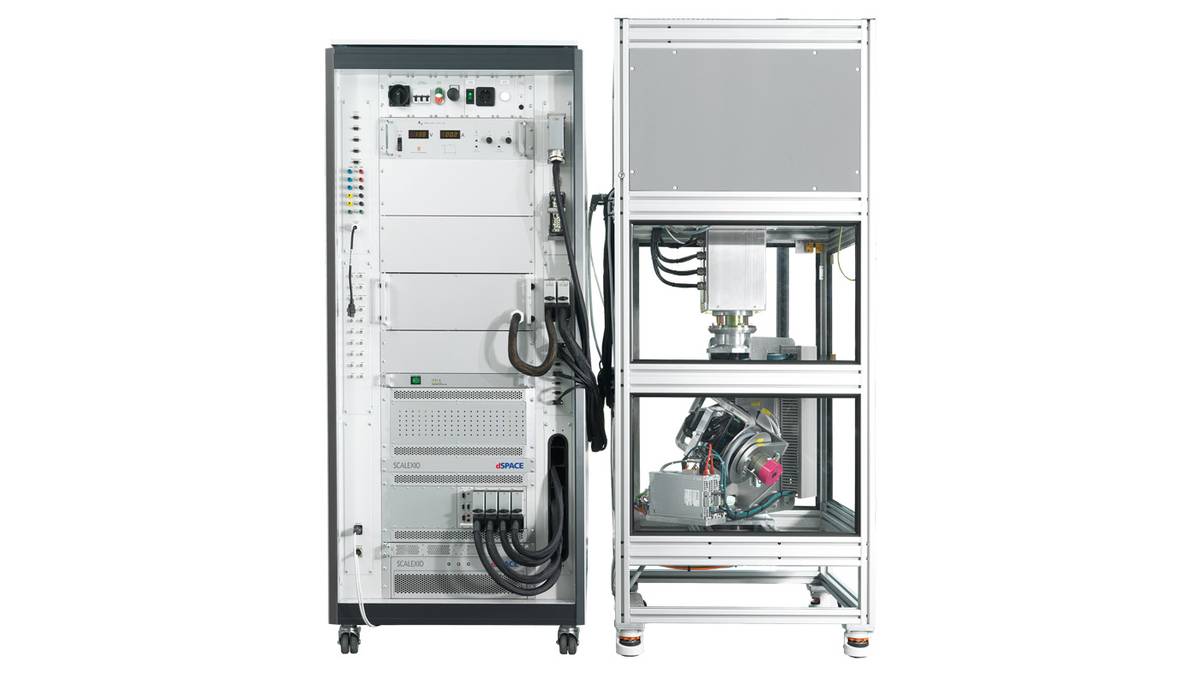
dSPACE test benches can be equipped with motion platforms to stimulate sensors and actuators that cannot be accessed otherwise.
- For chassis systems and vehicle dynamics
- Pitch and roll motion to simulate the lateral and/or longitudinal acceleration using gravity
- Unlimited rotary motion around the vertical axis to simulate the yaw rate
Key Benefits
Test benches can also include a motion platform for electronic control units (ECUs) to stimulate the ECU’s integrated sensors. These systems allow for the stimulation of acceleration sensors and yaw rate sensors that cannot be accessed otherwise.
A dSPACE SCALEXIO system can provide additional physical variables from the environment simulation and simulate any missing components.
A typical use case for test benches with 3-D motion platforms is testing ECUs with integrated sensor clusters, such as those found in electronic stability program (ESP), also referred to as electronic stability control (ESC), applications. The sensor cluster is mounted inside a 3-D motion platform so it can be rotated around three axes to simulate the motion of a vehicle.
Available Interfaces for Industrial Drive Inverters
dSPACE offers different interfaces for industrial drive inverters depending on your requirements.
For motion platforms, a robust, industry-proven bus interface is required, since at least two inverters are integrated on the rotating platform and the interface must be routed to the rotating axis using slip rings. For this purpose, the SCALEXIO Fieldbus Solution is used to interface the industrial drive inverters via the EtherCAT protocol. An average dynamic update rate of 0.5 ms is sufficient for this application.
| Parameter | Specification |
|---|---|
| Pitch and roll motion |
|
| Rotary motion |
|
Drive innovation forward. Always on the pulse of technology development.
Subscribe to our expert knowledge. Learn from our successful project examples. Keep up to date on simulation and validation. Subscribe to/manage dSPACE direct and aerospace & defense now.