For electric vehicles, power electronics are critical for several functions, but perhaps most relevant of all is the traction inverter, which converts the DC power from a high-voltage (HV) battery into AC power to supply the traction drives of an electric vehicle. Today, different drive concepts like front-axis drive, rear-axis drive, or even wheel hub motors require high precision, higher fundamental frequencies, and different motor concepts. The focus of development is always on increasing performance and efficiency, which leads to new control approaches, drive concepts, power electronics devices (e.g., silicon carbide SiC), and motor types. The drive unit is used by different vehicle functions and has to be integrated into the vehicle network. This also makes the integration process and the development of interfaces more complex.
In addition, electric drive systems are also used in a wide range of other applications. Similar drive systems and control approaches with even more powerful motors are used in industrial applications as well as aircraft, railway and off-highway applications. And electric vehicles of today are equipped with numerous auxiliary drives in applications such as air conditioning, electromechanical power steering or electronic braking systems.

Challenges
Compared to conventional engines, where the control unit only provides the control signals and the energy is generated by combustion, control units of electric drives must provide the complete actuation power. This results in special requirements for interfacing the development and test systems. In addition, electric systems are far more dynamic and therefore require significantly accelerated simulations. Since the electric drive is not only used for propulsion but also for braking through recuperation, this system is safety-critical and requires extensive testing during the development phase and successive validation of new software releases. This results in a wide range of test requirements. dSPACE systems support all stages during development, from rapid prototyping to code generation, SIL, HIL, and even power HIL simulation, always helping our customers enhance reliability, energy density, and efficiency. The following points are crucial for reaching these goals:
- Increased switching frequencies
- More advanced motor and power electronics topologies
- Increased controller performance and complexity
- Increased system voltages of more than 1,000 V
Our Solutions for Traction Motors
dSPACE offers comprehensive solutions for software-in-the-loop (SIL) testing, rapid prototyping, ECU autocoding as well as hardware-in-the-loop (HIL) and power HIL simulation. The portfolio includes powerful real-time processors, cutting-edge FPGA platforms, and comprehensive I/O interfaces. The dSPACE portfolio also offers high-performance electronic loads for testing with real power, ready-to-use FPGA-based model libraries for I/O processing and for controller or plant models, and advanced models including multi-phase drives, simulation of non-linear effects, and failure simulation. The dSPACE software supports the transition from function models in Simulink® to real-time processor and FPGA applications.
Highlights
- Tailored I/O function for high-speed controller design
- Scalable hardware allowing for customized applications
- Testing traction motor inverters with real currents
- Changing model parameters during run time
Rapid Prototyping

Function Development for the Main Traction Unit
You need in-vehicle and laboratory systems for fast and convenient development and verification of the main traction unit? In the development of algorithms for e-drive control, real-time performance and high-quality signal processing are the basis for success. With dSPACE, you can wrap all this into a robust and flexible package with convenient access. No matter whether you want to develop high-level functions using predefined library blocks or whether you want to implement your ideas with FPGA and without performance limits.


HIL Testing

Central Test Method for Validating ECUs
The SCALEXIO system for HIL simulation provides a wide range of I/O hardware, which enables you to connect various converter and motor types. You can program applications for the FPGA of the dSPACE FPGA base boards using the Xilinx® Vitis™ Model Composer HDL Library. Together with the FPGA Programming Blockset, the ready-to-use model libraries speed up your tasks. You can test the program in an offline simulation before implementation on the real-time hardware. This lets you respond flexibly to new requirements.

Power HIL Testing

High-Voltage Testing of Traction Motor Components
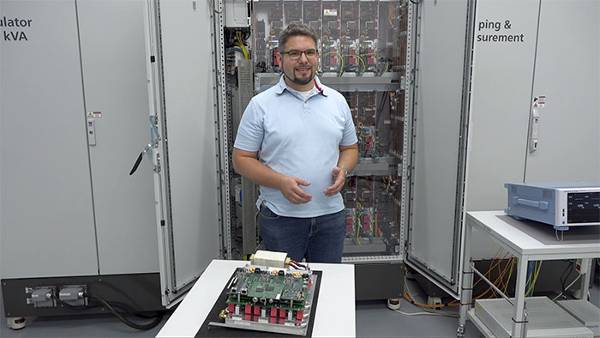
dSPACE offers a sophisticated, highly scalable system for testing and improving electrical components of powertrains, such as traction motor inverters. Using multiple high-voltage electronic loads in parallel generates several megawatts of power. One emulator cabinet can house up to 18 high-voltage electronic load modules. All power cabinets of the scalable system communicate with a SCALEXIO real-time system via the dSPACE network technology IOCNET, allowing for fast, low-latency communication.
Bus & Network Communication

SIL Testing

Software-in-the loop (SIL) testing with the powerful dSPACE solution for PC- and cloud-based simulation
With the dSPACE solution for software-in-the loop (SIL) testing, you can significantly accelerate your software development process by testing and validating virtually. dSPACE offers you a complete, modular, scalable development and test solution. You can conveniently simulate a device-under-test on a PC, connect it to physics-based models, run scalable tests in the cloud, and then easily reuse test scripts on hardware-in-the-loop (HIL) systems.
Test Data Management

Data Management and Collaboration Software for Automated ECU Testing
SYNECT, our solution for the efficient and automated verification and validation of ECU software, helps engineers worldwide handle all test parameters, their dependencies, versions and variants, and the underlying requirements throughout the entire development process.
This results in consistent data versions and complete traceability as required in homologation processes, and an efficient reuse of data in other projects.
Production Software Development

Optimized Production Software Development
The central challenges in production software development include the optimization of RAM resources, run time, and integration into the overall system. Furthermore, it must be possible to split the software in such a way that regular software updates are possible. And before the final software release, special validation and often a release process are required.
Simulation Modeling


Development support from start to finish
Developing complex E/E systems and software with ever more safety-critical functions, especially in the area of autonomous systems, raises the question of guaranteeing function reliability. That's why dSPACE offers end-to-end expertise in functional safety, test strategy development as well as verification and validation in complex E/E processes - to support you from the earliest project stages to homologation.
dSPACE systems are easy to get up and running – however, if a project is more complex, if individual solutions are needed or if there is high time pressure, you can also trust dSPACE's fast, competent and reliable engineering services.